

If you find it hard to follow conversations in busy Indian markets or during family get-togethers, you are not alone. If your family often tells you that the TV volume is too loud, it could be a sign that your hearing needs attention.
Many people in India face some level of hearing loss, but they delay getting help. One common reason is uncertainty; they are not sure what happens during a professional hearing test or evaluation.
A hearing test is a simple, painless, and fascinating process. It is the first step toward reconnecting with the sounds that matter most in your life again, from the laughter of your grandchildren to your morning prayers.
At SFL Hearing Solutions, we believe that transparency builds trust. A hearing check-up is simple, comfortable, and helpful. It can clearly show what you are missing and guide you toward the right solution, so you can enjoy conversations and everyday sounds again. In this guide, we will walk you through exactly what happens when you visit an audiologist in India, helping you prepare for your journey toward better hearing.
Why You Shouldn’t Delay Your Hearing Test
In many Indian households, people often believe that becoming “hard of hearing” is just a normal part of growing older. Because of this belief, many ignore the early signs and do not seek help on time.
However, untreated hearing loss is not something to take lightly. It can affect your daily life in many ways. When you cannot hear clearly, you may start avoiding conversations and social gatherings. Over time, this can lead to feelings of loneliness and isolation.
It can also impact your mental health, sometimes causing stress or depression. In some cases, long-term hearing loss has even been linked to a decline in memory and thinking ability.
The good news is that with the right care and timely support, these problems can often be managed or reduced.
By searching for a hearing aid centre near me and booking an assessment, you are taking a proactive step. Early detection means more treatment options and a much higher success rate in preserving your remaining hearing.
Step 1: The Case History (The Conversation)
The process doesn’t start with machines; it starts with a conversation. The audiologist in India will ask you about your lifestyle and medical history. In an Indian context, this often includes:
- Work Environment: Do you work in a noisy factory or near heavy traffic?
- Daily Challenges: Do you struggle specifically during family dinners or while talking on the phone?
- Medical History: Have you had frequent ear infections (common during the monsoon) or a history of diabetes/blood pressure?
- Symptoms: Are you experiencing “ringing” (tinnitus) or a feeling of fullness in the ears?
This “case history” helps the specialist in understanding the type of hearing issues you might be facing in a better way.
Step 2: Visual Inspection (Otoscopy)
Before the electronic testing begins, the audiologist will first examine your ears with a small handheld instrument called an otoscope. This device has a light that helps the audiologist look inside your ear canal and check the condition of your eardrum.
This is a quick and painless step. It helps the audiologist make sure your ears are healthy before moving on to the hearing test.
The specialist is looking for:
- Earwax Blockage: Sometimes, “hearing loss” is just a stubborn plug of wax!
- Infections: Redness or fluid discharge.
- Structural Issues: Any visible damage to the eardrum or unusual growths.
If your ear is blocked with wax, the audiologist will provide ear care tips or professional cleaning before proceeding with the test.
Step 3: Tympanometry (Middle Ear Check)
This test doesn’t measure how well you hear, but how well your middle ear is functioning. A small probe is placed in the ear, and it gently changes the air pressure.
It helps identify:
- Fluid behind the eardrum (common in children or after a cold).
- Stiffness of the eardrum.
- Issues with the tiny bones in your middle ear.
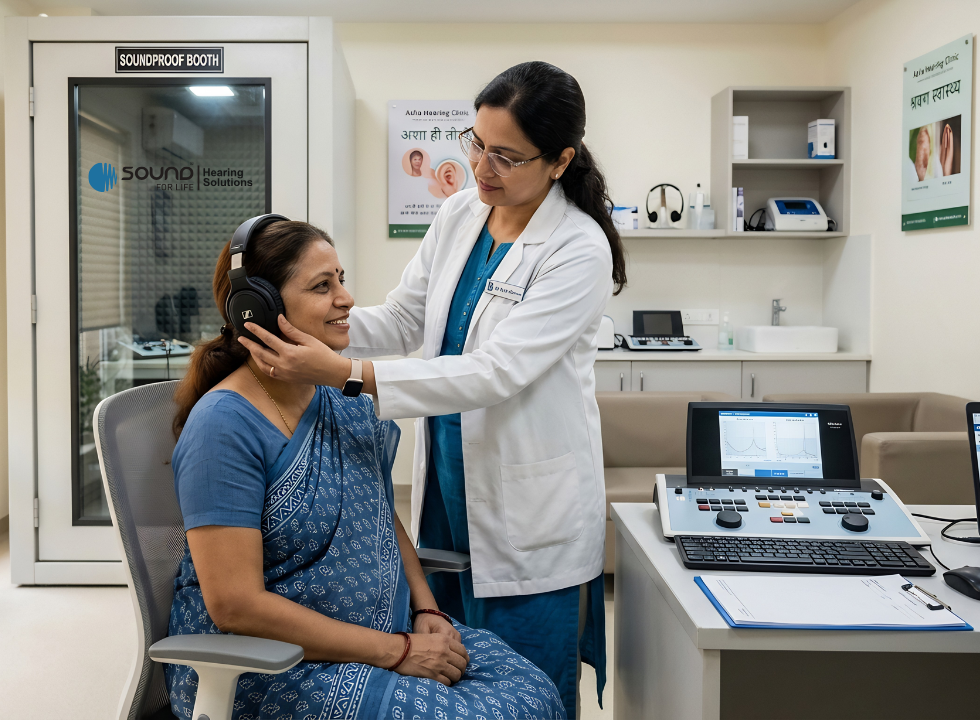
Step 4: Pure Tone Audiometry (The “Beep” Test)
This is the core of the hearing test. You will be asked to sit in a sound-treated booth and wear a pair of headphones.
The audiologist will play a series of tones at different pitches (frequencies) and volumes. Your task is simple: press a button or raise your hand every time you hear a sound, even if it is very faint.
- Air Conduction: Testing sounds through headphones to check the entire hearing pathway.
- Bone Conduction: A small vibrator is placed behind your ear. This bypasses the outer/middle ear and checks the health of your inner ear (cochlea) directly.
Step 5: Speech Testing
Hearing a “beep” is one thing, but understanding a conversation is another. During speech testing, you will hear a series of words at different volumes and be asked to repeat them.
In India, where we speak multiple languages, your audiologist may perform this in your preferred tongue to ensure the most accurate results. This test determines your “Speech Recognition Threshold” (the softest level you can understand speech) and your “Word Recognition Score” (how clearly you understand words when they are loud enough).
Step 6: Reviewing Your Audiogram
Once the tests are complete, the results are plotted on a graph called an audiogram. This graph is a “map” of your hearing.
- The Vertical Axis: Represents volume (decibels).
- The Horizontal Axis: Represents pitch (frequency).
Your audiologist will explain if your hearing loss is Conductive (an issue in the outer/middle ear), Sensorineural (an issue in the inner ear/nerve), or Mixed.
What Happens If Hearing Loss is Found?
If the results show that you may need support, your audiologist will explain the next steps clearly. At this stage, visiting a specialized hearing aid centre can be very helpful.
Modern hearing aids are very different from the bulky, whistling devices people used years ago. Today, they are smaller, smarter, and more comfortable to use. They also come with advanced features that can improve your hearing experience in daily life, such as clear sound, noise reduction, and easy connectivity.
- AI-Driven Sound Processing: To filter out the noise of Indian traffic while enhancing speech.
- Bluetooth Connectivity: Stream calls directly from your smartphone.
- Rechargeable Batteries: Convenient for a busy lifestyle.
Essential Ear Care Tips for Every Indian Home
While you wait for your appointment, start practicing these ear care tips to protect your hearing:
- Stop the Swabs: Never put cotton buds, matchsticks, or keys in your ears. The ear is self-cleaning!
- The 60/60 Rule: When using headphones, listen at no more than 60% volume for 60 minutes a day.
- Protect Yourself from Noise: During Diwali or loud weddings, use earplugs to prevent acoustic trauma.
- Dry Your Ears: After bathing, use a soft towel to dry the outer ear to prevent fungal infections (Otomycosis), which are very common in India’s humid climate.
- Regular Check-ups: Just like a dental cleaning, a yearly hearing check-up should be part of your health routine after age 50.
Why Choose SFL Hearing Solutions?
When choosing an audiologist in India, it is important to find someone who has both strong medical knowledge and a caring approach. You need a professional who not only understands hearing problems but also listens to your concerns and makes you feel comfortable.
At SFL Hearing Solutions, we focus on providing accurate and reliable care. We use advanced, modern diagnostic equipment to make sure your hearing assessment is detailed and precise.
Our main goal is to make your hearing better, not just selling hearing aids. We offer a complete hearing care program that is designed around your needs. This includes guidance, fitting, and ongoing support, all tailored to suit your daily life and routine in India.
FAQs: Everything You Need to Know About Hearing Tests
Question 1. Does a hearing test hurt?
Answer: Not at all. It is a non-invasive, painless process that involves listening to sounds and repeating words.
Question 2. How long does the entire assessment take?
Answer: A comprehensive evaluation usually takes between 45 minutes to an hour. This includes the case history, testing, and the consultation.
Question 3. Can I take a hearing test if I have a cold?
Answer: It is better to wait until your cold or sinus infection has cleared. Fluid in the ears from a cold can temporarily affect your results.
Question 4. How often should I get my hearing tested?
Answer: If you are over 50, an annual test is recommended. If you work in a noisy environment, you should have it checked every year regardless of your age.
Question 5. Will I have to buy a hearing aid immediately?
Answer: Not necessarily. The test is a diagnostic tool. Your audiologist will recommend the best course of action, which could range from simple wax removal to medical referrals or hearing technology.
Take the First Step towards better Hearing, Today
Hearing is one of our most valuable senses. It helps us stay connected with our family, our friends, our culture, and the world around us. If you have been managing unclear or muffled sounds for a long time, it is time to stop guessing and start hearing clearly.
A professional hearing test is the best way to understand what is really happening with your ears. It gives you a clear picture of your hearing health and helps you take the right next step with confidence.
Whether you live in a busy city or a quiet town, expert hearing care may be closer than you think. Search for an audiologist in India today and take the first step toward enjoying the sounds of life again.
Book a free hearing consultation at SFL Hearing Solutions | Call: +91 90 1540 1540
Disclaimer: This article is for educational purposes only. Please consult a qualified audiologist for personalized advice.