
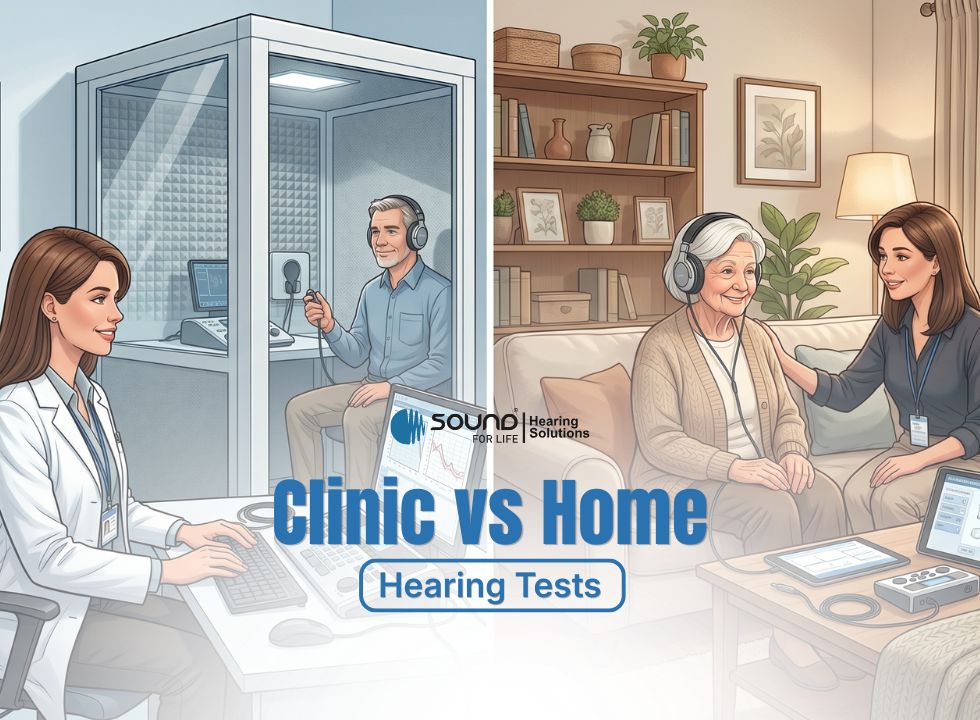

In modern India, where life moves quickly, convenience has become a top priority. We get our groceries delivered in ten minutes, consult doctors via video calls, and have lab tests conducted from the comfort of our living rooms. It is only natural that the field of audiology has followed suit. Today, if you suspect you are suffering from hearing loss, you have two primary paths: visiting a professional clinic or opting for a home-based assessment.
But when it comes to something as vital as your sense of hearing, is convenience always the best choice? Whether you are navigating the heavy traffic of Bengaluru or living in a quiet town in Kerala, choosing the right environment for your hearing test can significantly impact the accuracy of your results and the quality of your long-term treatment.
At SFL Hearing Solutions, we provide both in-clinic and home-visit services. In this comprehensive guide, we will break down the pros and cons of each to help you decide which service is the perfect fit for your lifestyle.
The Rise of Home Audiology Services in India
Home-based hearing services have become very popular in India in recent years, especially as people have changed the way they approach healthcare. For many people, the thought of searching for a hearing aid centre near me, dealing with heavy traffic, and waiting in a crowded clinic can feel tiring and inconvenient. That is why more and more people now prefer hearing care at home, where they can get support in the comfort of their own environment at their convenient time.
Home visits are especially beneficial for:
- Senior Citizens: Those with mobility issues or those who rely on family members for transport.
- Busy Professionals: Individuals who cannot take a half-day off work to visit a clinic.
- Post-Operative Patients: Those recovering from surgery who need to minimize physical exertion.
Although getting services at home is very comfortable and convenient, it is important to understand that there can be some technical limitations or trade-offs involved.
The Gold Standard: Why Clinic Tests Excel
When you visit a certified audiologist in India at a dedicated clinic, you are stepping into a carefully controlled environment that is designed especially for accurate hearing evaluation and sound testing.
1. The Sound-Treated Booth
The biggest advantage of visiting a clinic is the soundproof room used for hearing tests. In everyday environments, background sounds like a pressure cooker whistle, a barking dog, or even the constant hum of a ceiling fan can affect how well you hear soft “beep” sounds during the test.
In a clinic, these outside noises are completely blocked. This creates a quiet and controlled space where you can focus only on the test sounds. As a result, your hearing test is much more accurate and reliable.
2. Advanced Diagnostic Equipment
While portable equipment has come a long way, clinics house large-scale diagnostic tools that aren’t easily transported. This includes advanced middle-ear analyzers and specialized equipment for complex cases like vertigo or deep-seated nerve issues.
3. Immediate Access to Repairs and Stock
If the test reveals you need a device, a clinic allows you to see, touch, and try on dozens of different models instantly. You can compare the discreet “In-the-Ear” models with powerful “Behind-the-Ear” devices on the spot.
The Comfort Choice: The Benefits of Home Hearing Tests
Despite the clinical advantages, home visits offer a unique “real-world” perspective that a booth cannot replicate.
1. Testing in Your Natural Environment
One of the biggest complaints of people with hearing loss is that they can’t hear the doorbell or the TV. When an audiologist tests you at home, they can calibrate your hearing aids to the exact acoustics of your living room.
2. Reduced Anxiety
Many patients, especially the elderly, experience “white coat syndrome”, elevated stress levels in a medical setting. Testing at home, while sipping a cup of chai in a familiar chair, leads to a more relaxed state, which can sometimes result in more consistent responses during the assessment.
3. Family Involvement
In the Indian family structure, health decisions are often communal. A home visit allows children, spouses, and caregivers to be part of the conversation, helping them understand how to support their loved one’s ear health and follow ear care tips.
Comparing the Technical Process
Whether at home or in the clinic, a professional audiologist in India will follow a standardized protocol. However, the “depth” can vary:
| Feature | Clinic Assessment | Home Assessment |
| Ambient Noise | Zero (Soundproof Booth) | Variable (Background Noise) |
| Equipment | Full Diagnostic Suite | Portable Calibrated Kits |
| Physical Exam | Video Otoscopy available | Standard Otoscopy |
| Accuracy | Highest (Clinical Standard) | High (Screening Standard) |
| Convenience | Requires Travel | Zero Travel |
Understanding the “Indian Factor” in Choice
In India, environmental factors play a very important role in hearing tests and audiology. Everyday surroundings are often filled with different types of background noise, which can affect how accurately a person’s hearing is checked. Because of this, it becomes essential to consider the environment when testing and evaluating hearing.
The Noise Challenge: If you live near a main road, a construction site or a noisy factory, a home hearing test might be compromised by external noise. In such cases, a clinic visit is highly recommended to avoid “false” results.
The Climate Factor: India’s dust and humidity are enemies of hearing technology. A clinic visit allows for professional “Deep Cleaning” of devices using vacuum pumps and UV driers that a portable kit might not include.
Essential Ear Care Tips for Everyone
No matter where you get your hearing test done, taking care of your ears is something you need to do every day. Good ear care is a daily habit, especially in our environment where dust, noise, and pollution are common.
Here are some simple and important ear care tips that are practical for our surroundings:
- Avoid “Street” Ear Cleaners: You may still see traditional ear cleaners in some Indian markets. Never use their services. They use unsterilized tools that can cause permanent damage or severe infections.
- Keep it Dry: During the monsoon, fungal infections (Otomycosis) spike. Ensure you dry your ears thoroughly after getting caught in the rain.
- Volume Control: Whether it’s a Bollywood movie or a bhajan, keep the volume at a moderate level. If you have to shout to be heard over your music, it’s too loud.
- Manage Your Diabetes: India is often called the diabetes capital of the world. High blood sugar can damage the small blood vessels in the ear, leading to sudden hearing loss. Keep your levels in check to protect your ears.
How to Prepare for Your Hearing Test (Home or Clinic)
To get the most accurate results, follow the given steps before booking your appointment:
- Quiet Time: Avoid loud noises (like loud music or machinery) for at least 12 hours before the test.
- Check for Wax: If you feel a blockage, mention it when booking. The audiologist can then bring tools for wax removal.
- List Your Struggles: Write down three specific situations where you find it hardest to hear. This helps the specialist program your solution more effectively.
- Bring a Companion: A familiar voice is used during speech testing to see how well you recognize sounds you hear every day.
Which Service Should You Choose?
Choose a Clinic Visit if:
- You suspect your hearing loss is complex or sudden.
- You live in a very noisy neighborhood.
- You want the widest range of technology to try on.
- You are a first-time wearer who needs a comprehensive initial setup.
Choose a Home Visit if:
- You have mobility issues or are of advanced age.
- Your home is relatively quiet during the day.
- You want to see how hearing aids perform in your actual living space.
- You are looking for a routine follow-up or minor adjustment.
FAQs: Clinic vs. Home Services
Question 1. Is a home hearing test as accurate as a clinic test?
Answer: While portable equipment is highly calibrated, the clinic remains the “gold standard” because of the soundproof booth. However, for 90% of standard age-related hearing cases, a home test is more than sufficient for a successful fitting.
Question 2. Do home visits cost more?
Answer: Usually, there is a nominal “home visit fee” to cover the audiologist’s travel and the transport of sensitive equipment. However, when you factor in your own travel time and fuel/cab costs in Indian traffic, the difference is often negligible.
Question 3. Can I buy hearing aids during a home visit?
Answer: Yes! Most audiologists bring a selection of trial devices. If you find a pair you like, they can often be programmed and fitted right then and there.
Question 4. What if my home is too noisy?
Answer: If the audiologist arrives and finds the environment too loud (e.g., neighbor’s construction), they may suggest rescheduling or moving the test to a clinic. Accuracy is the priority.
Question 5. Can children be tested at home?
Answer: For children, a clinic visit is almost always preferred. Pediatric audiology requires very specific, often bulky equipment and a highly controlled environment to get accurate readings from a child who might not be able to follow instructions perfectly.
Quality Care, Wherever You Are
At the end of the day, the best hearing care is the one that truly helps you get the support you need. If a long commute makes it difficult for you to seek help for your hearing loss, a home visit can be a very helpful and life-changing option. On the other hand, if you are looking for the highest level of accuracy and want access to a wider range of testing and treatment options, then a clinic is the right place to go.
At SFL Hearing Solutions, our mission is to make world-class ear care accessible to every Indian home. Whether we see you at our state-of-the-art facility or sit with you in your living room, you can expect the same level of expertise from our leading audiologist in India.
Stop waiting for the world to get louder. Take control of your hearing health today.
Book a free hearing consultation at SFL Hearing Solutions | Call: +91 90 1540 1540
Disclaimer: This article is for educational purposes only. Please consult a qualified audiologist for personalized advice.