

Walk into any metro station in Delhi, a trendy café in Bangalore, or a co-working space in Mumbai, and you’ll see the same sight: hundreds of young Indians with colorful earbuds tucked firmly into their ears.
Whether it’s binge-watching a new Netflix series on the commute, attending back-to-back Zoom calls, or “grinding” in a late-night gaming session, earbuds have become an extension of the modern Indian body. But while these tiny devices provide us with a private soundtrack to our lives, they are also driving a silent health crisis.
We aren’t just talking about traditional hearing loss, the kind where you can’t hear a doorbell. We are talking about something much more subtle and potentially more frustrating: Hidden Hearing Loss (HHL).
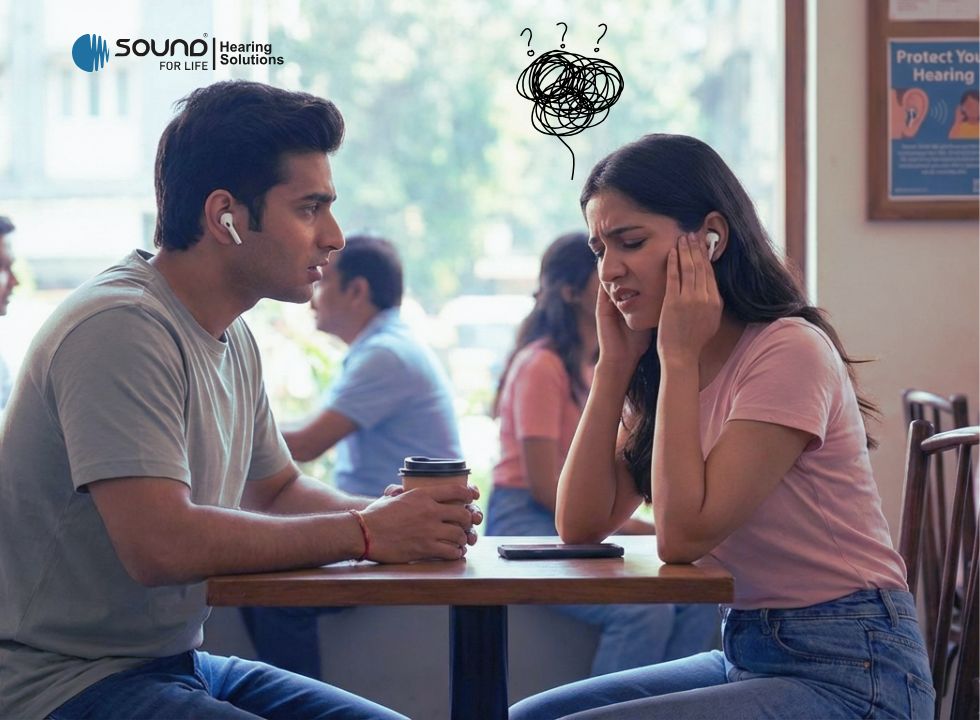
At SFL Hearing Solutions, we are seeing an unprecedented rise in young adults, Gen Z and Millennials, who complain that they “can hear, but they can’t understand.” If you find yourself constantly asking “Kya bola?” (What did you say?) If you can hear “normally” yet still have trouble hearing at a loud restaurant, this guidance is for you.
What Exactly is “Hidden” Hearing Loss?
Traditional hearing loss usually involves damage to the tiny hair cells in the inner ear (the cochlea). When these cells die, a standard hearing test (audiogram) easily detects the drop in sensitivity.
However, Hidden Hearing Loss is different. It doesn’t damage the hair cells initially; instead, it damages the synapses, the delicate bridges that connect those hair cells to the auditory nerve that sends signals to your brain.
- The Result: You pass a basic hearing test in a quiet room with flying colors. But the moment you step into a busy Indian market or a wedding hall, your brain can’t “filter” the noise. The speech sounds like a muddled jumble.
The Indian “Earbud Boom”: A Recipe for Disaster
The Indian “Earbud Boom”: A Recipe for Disaster
Why is this hitting Indian youth so hard? The answer lies in our changing lifestyle and the unique acoustic environment of our country.
1. The “Commuter’s Trap”
In cities like Kolkata or Chennai, public transport is loud. The ambient noise of a bus or a local train can easily reach 80–85 decibels (dB). To hear their music over this roar, most youth crank their earbud volume to 90% or 100%. To put this into perspective, this is the same as standing next to a lawnmower for two hours each and every day.
2. The Rise of the “Gamer” Culture
With the explosion of mobile gaming in India, young players spend 4 to 6 hours daily with headsets on. The sudden “peak” sounds of explosions or gunfire in games are particularly damaging to the auditory synapses.
3. Work-From-Home (WFH) Fatigue
The shift to remote work meant that “meeting fatigue” became real. Many young professionals in the IT sector wear earbuds for 8–10 hours a day. Even at lower volumes, this constant pressure of sound waves against the eardrum leads to auditory fatigue.
Why Standard Tests Often Miss the Problem
Many young Indians visit an audiologist in India only after they feel something is wrong. However, if the audiologist only performs a “Pure Tone Audiometry” (the standard test where you beep when you hear a sound), the results might come back as “Normal.”
This leads to a frustrating cycle:
- The patient feels they can’t hear well in groups.
- The test says they are fine.
- The patient ignores the problem until the damage becomes irreversible.
At SFL Hearing Solutions, we advocate for more advanced “Speech-in-Noise” testing. This measures how well your brain processes words when there is background babble, the ultimate test for Hidden Hearing Loss.
The Warning Signs: Are Your Earbuds Hurting You?
Because HHL is “hidden,” you have to be your own detective. Look out for these red flags:
- The “Cocktail Party” Struggle: You struggle to follow a conversation at a family dinner or a café, even though the person is sitting right across from you.
- Tinnitus: A faint ringing, buzzing, or hissing sound in your ears after you take your earbuds out.
- Volume Creep: You notice that the volume level you used six months ago now feels “too quiet.”
- Muffled Speech: People sound like they are mumbling, or you feel like you have “cotton wool” in your ears.
- Increased Exhaustion: You feel mentally drained after social gatherings because your brain is working ten times harder to “decode” speech.
The Impact of Indian Culture: Weddings and Festivals
We can’t blame earbuds alone. India is a land of celebration, but our celebrations are loud.
- The Baraat Factor: Standing near a mobile DJ truck during a wedding can expose your ears to 110–120 dB.
- Religious Festivals: The use of high-decibel loudspeakers during Pandals or processions adds a massive “noise load” to our ears.
When you combine these cultural noise exposures with daily earbud use, the auditory nerve never gets a chance to recover. This “cumulative damage” is why we see 25-year-olds with the hearing profiles of 50-year-olds.
Essential Ear Care Tips for the Digital Generation
You don’t have to throw your earbuds away! You just need to use them smarter. Follow these ear care tips to protect your future:
You don’t have to throw your earbuds away! You just need to use them smarter. Follow these ear care tips to protect your future:
1. The 60/60 Rule
This is the golden rule of ear health. Listen at no more than 60% volume for no more than 60 minutes at a time. After an hour, give your ears a 10-minute “sound fast” (complete silence).
2. Invest in Noise-Canceling Headphones
It sounds counterintuitive, but active noise-canceling (ANC) headphones are better for your ears. Why? Because they block out the external noise of the Indian streets, meaning you don’t feel the need to “crank up” the volume to drown out the world.
3. Choose Over-the-Ear Instead of In-Ear
Earbuds (the ones that sit inside your ear canal) are closer to the eardrum and increase the sound pressure by about 7–9 decibels. Over-the-ear headphones are generally a safer bet for long-term use.
4. Use the “Arm’s Length” Test
If someone standing an arm’s length away from you can hear the music leaking out of your headphones, it is way too loud. Turn it down immediately.
Nutrition and Ear Health
In India, we have access to incredible natural boosters. While they won’t “cure” HHL, they help protect the nerves.
| Nutrient | Why it helps | Indian Source |
| Omega-3 | Strengthens sensory cells | Walnuts (Akhrot), Flaxseeds (Alsi) |
| Magnesium | Acts as a barrier to noise damage | Pumpkin seeds, Spinach (Palak) |
| Vitamin B12 | Crucial for nerve health | Milk, Curd (Dahi), Paneer |
The Path to Recovery: What Should You Do?
If you suspect your hearing is changing, don’t wait for it to get worse.
- Limit the Noise: The first step is “Auditory Rest.” Limit your earbud or headphone use to essential calls only for a week.
- Professional Consultation: Don’t just search for a “hearing aid centre near me” and buy the first device you find. Hearing loss is a medical issue, so the right first step is a full diagnostic evaluation by a qualified audiologist or ENT specialist. A proper evaluation looks at your medical history, checks your ears, runs hearing tests, and identifies the type and severity of your hearing loss. A clinic will also measure your ear, adjust settings, provide follow-up appointments, teach you how to use and care for the device, and offer warranty and aftercare services you won’t get from an off-the-shelf purchase.
- Get a Specialized Hearing Test: Ask for a high-frequency audiometry and a speech-in-noise test. This will reveal the “hidden” damage that standard tests miss.
Finding a qualified audiologist in India is easier than ever. At SFL Hearing Solutions, we use advanced diagnostic equipment to create a detailed map of your hearing and provide a personalised plan to protect or restore your auditory health. The detailed assessment helps us identify risks, determine the exact type and degree of hearing loss, and build a clear, customised roadmap for prevention, treatment, or correction. We then guide you through device selection, precise fittings, and ongoing follow-up so you get comfortable, effective care that lasts.
Frequently Asked Questions (FAQs)
Question 1. Can Hidden Hearing Loss be cured?
Answer: Currently, there is no “pill” to regrow the synapses between the ear and the brain. However, the brain is plastic! If you catch it early and reduce noise exposure, your brain can often learn to compensate. For more advanced cases, specialized hearing technology can help “filter” noise.
Question 2. Are “local” cheap earbuds more dangerous?
Answer: Often, yes. Cheap, unbranded earbuds usually have poor sound balance, forcing you to turn up the volume to hear the “mids” and “vocals,” which increases the risk of damage.
Question 3. My hearing test was normal, but I still struggle. Am I imagining it?
Answer: Not at all. This is the hallmark of Hidden Hearing Loss. Your “ears” are fine, but the “cables” connecting them to your brain are frayed. You need a specialized speech-in-noise evaluation.
Question 4. Do noise-canceling earbuds emit harmful radiation?
Answer: No. Active Noise Cancellation (ANC) works by creating an “opposite” sound wave to cancel out external noise. It is a purely acoustic process and is perfectly safe for your brain.
Question 5. Can I use earwax removal drops to fix this?
Answer: Earwax can cause muffled hearing, but it won’t cause the “speech-in-noise” struggle typical of HHL. If you have wax, see a professional; don’t use hairpins or matchsticks!
Question 6. Is Tinnitus always a sign of hearing loss?
Answer: Not always, but it is a very common “warning signal” from your auditory system that it is under stress. If you have ringing in your ears, it’s your body’s way of saying “Quiet, please!”
The Social and Mental Cost of Ignoring Your Ears
Hearing is our primary social sense. In India, where we live in “joint” environments and celebrate loudly, losing the ability to follow a conversation leads to:
- Social Withdrawal: You stop going to parties or weddings because it’s too much work to listen.
- Anxiety: The fear of mishearing a command at work or a question from a friend.
- Cognitive Decline: Research shows that untreated hearing issues can lead to an earlier onset of memory-related problems because the brain “atrophies” from lack of stimulation.
Take Back the Silence
The Indian youth are the backbone of our country’s future. We are the coders, the creators, and the leaders. But we cannot lead effectively if we are disconnected from the world around us.
Hidden Hearing Loss is a modern issue, yet there is a straightforward remedy to this problem:
- Be Aware of it. It is possible to assure that you will continue to take pleasure in listening to your preferred music and engaging in meaningful discussions long into your 80s by making a few little adjustments, such as adhering to the 60/60 rule and undergoing frequent hearing tests.
At SFL Hearing Solutions, we are committed to helping the younger generation navigate the noisy modern world without losing their most precious sense. Your ears have been there for you through every song and every secret; it’s time you return the favor.
Book a free hearing consultation at SFL Hearing Solutions | Call: +91 90 1540 1540
Disclaimer: This article is for educational purposes only. Please consult a qualified audiologist for personalized advice.