
In the bustling streets of Mumbai, the metro rides in Delhi, or the tech parks of Bangalore, one thing is constant: almost everyone has headphones on. Whether you are listening to the latest Bollywood hits, catching up on a podcast during your commute, or attending back-to-back Zoom calls, headphones have become an extension of our bodies.
But have you ever stopped to wonder if that “High Volume” warning on your smartphone is just a suggestion or a serious red flag?
At SFL Hearing Solutions, we are worried about the surge in noise-induced hearing loss among young adults in India. Who did it? “Safe” ways to listen that aren’t safe at all. We’ll go over just how loud it is, too loud, how to enjoy your music safely, and why you should have a hearing test every year as part of your health check-up.
The Science of Sound: How Loud is Too Loud?
Sound is measured in decibels (dB). To understand headphone safety, we first need to understand the “danger zone.”
The World Health Organization (WHO) and audiologists worldwide generally agree that exposure to sounds above 85 dB for extended periods can cause permanent damage to your hearing. To give you some context:
- Normal conversation: 60 dB
- A busy Indian street (traffic/horns): 80–90 dB
- Maximum volume on a smartphone: 100–110 dB
- A rock concert or a Diwali cracker: 120+ dB
When you crank your headphones up to 100%, you are essentially subjecting your delicate inner ear to the same intensity as a power saw or a jet taking off. The scary part? You might not feel the damage immediately. Hearing loss from loud noise is often gradual and painless, until it’s too late.
The 60/60 Rule is the “Golden Rule” of Headphone Safety, and it should be followed.
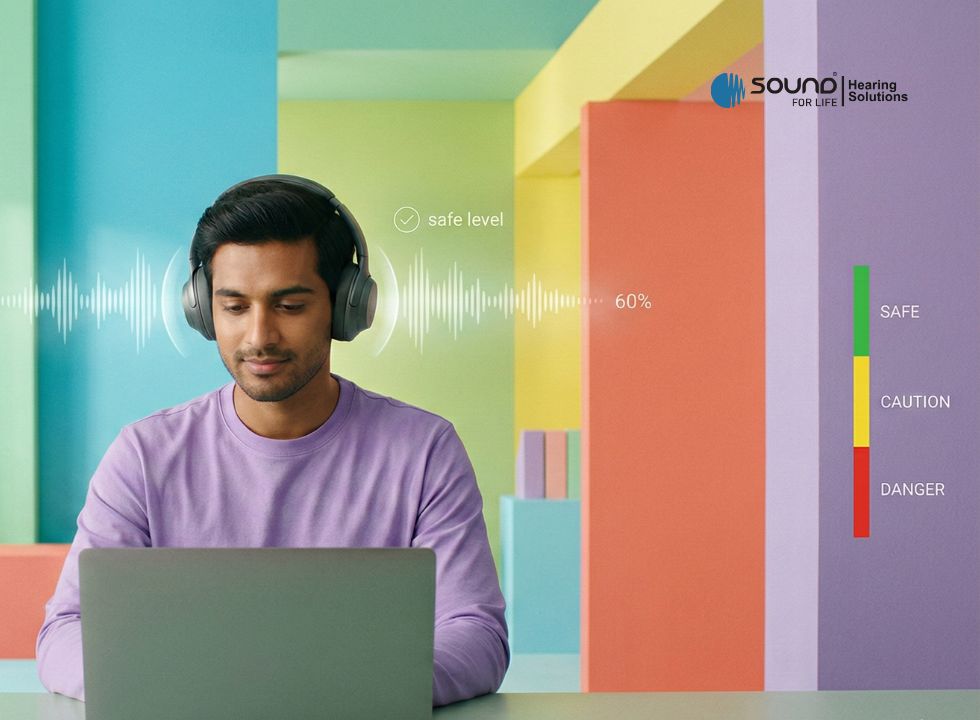
If you are to remember one item from this essay, make it the 60/60 Rule. It will ensure that you remember everything. It is a simple, human-friendly way to manage your ear health without giving up your favorite tunes.
- 60% Volume: Never set your headphone volume higher than 60% of the maximum.
- 60 Minutes: Limit your listening time to no more than 60 minutes at a stretch. After an hour, take your headphones off and give your ears a “quiet break” for at least 10 minutes.
This rule is particularly important in the Indian context, where we often use headphones to “drown out” the external noise of pressure horns, construction, or loud neighbors. By following this rule, you give the tiny hair cells in your inner ear a chance to recover.
Why the “Indian Environment” Makes Us Turn It Up
In India, we live in a naturally high-decibel environment. From the festive sounds of dhols during Ganesh Chaturthi to the constant hum of ceiling fans and air conditioners, our background noise level is high.
When we put on headphones in a noisy environment (like a public bus or a crowded office), we tend to turn the volume up just to hear the audio over the background noise. This is known as the “Masking Effect.” You might think your music is at a comfortable level, but in reality, you’ve pushed it to 90 dB or higher just to compete with the traffic outside.
This is why finding a professional audiologist in India is becoming increasingly important for the “Earphone Generation.” We are living in a noise epidemic, and our ears are paying the price.
The Danger of In-Ear vs. Over-Ear Headphones
Not all headphones are created equal when it comes to ear safety.
In-Ear Earphones (Earbuds)
These are popular because they are portable and cheap. However, they sit closer to the eardrum and can naturally increase the volume by about 7 to 9 decibels. Because they don’t block out background noise very well, users often crank them up to dangerous levels.
Over-Ear Headphones
These are generally a better choice for ear health. They cup the ear, providing better natural sound isolation. If you use high-quality, noise-canceling headphones, you are much less likely to turn the volume up to dangerous levels because the technology “cancels” the outside noise for you.
How Does Loud Noise Actually Damage Your Hearing?
Inside your ear, there is a snail-shaped structure called the cochlea. It is filled with fluid and thousands of tiny, microscopic “hair cells.” These cells pick up sound vibrations and turn them into electrical signals that your brain interprets as music or speech.
When you play music too loudly:
- The vibrations are too violent.
- The hair cells get overworked and eventually “bend” or break.
- Unlike the hair on your head, these ear hair cells never grow back.
Once they are gone, your ability to hear certain frequencies, usually high-pitched sounds like the voices of women and children, is lost forever. This might be considered the beginning of a lifelong loss of hearing.
Signs you might already have damage from noise:
Here are clear, simple warning signs to watch for if you use headphones a lot. If you notice any of these, take them seriously.
1. Ringing or buzzing (tinnitus)
You hear a ringing, buzzing, hissing, or whistling sound that stays with you when it’s quiet. It might come and go, or stay all the time.
2. Speech sounds muffled
Voices sound soft, unclear, or like people are mumbling. You can hear someone talking but you can’t make out the words.
3. Saying “What?” a lot
You find yourself asking people to repeat themselves, especially in noisy places like restaurants or streets.
4. Ear feels full or clogged
After taking off your headphones you feel pressure, fullness, or like your ear is blocked — even though there is nothing in your ears.
5. Need the volume higher than before
You keep turning up the music or TV louder than you used to so you can hear. This is a big red flag.
6. Sounds seem dull or less sharp
High-pitched sounds (like birds or beeps) are weaker or missing.
7. Trouble hearing on the phone
Voices on calls sound faint or unclear, and you struggle more on the phone than in person.
8. Trouble with balance or ear popping
You notice dizziness, unsteady feeling, or frequent ear popping — these can sometimes go with ear problems.
What to do if you notice these signs
If you spot one or more of these, stop using loud headphones and see a hearing specialist (audiologist) or an ENT doctor. Early checkups can help protect what hearing you have left. Simple changes lowering volume, using noise-cancelling headphones, and taking listening breaks can also help right away.
Essential Ear Care Tips for Every Headphone User
Protecting your hearing doesn’t mean you have to live in silence. It’s about balance. Here are some useful recommendations for taking care of your ears to keep your hearing sharp:
- Invest in noise-cancelling technology. It’s worth it. It lets you listen to music at much lower, safer levels.
- Look at the safety settings on your phone: A lot of new iPhones and Androids include a “Headphone Safety” option in their settings. You may set a “Decibel Limit” so that the phone won’t allow the sound to go too loud.
- The “Arm’s Length” Test: If someone standing an arm’s length away from you can hear the music coming from your headphones, it’s too loud.
- Don’t Use Headphones When You’re fatigued: Your ears are more likely to get fatigued and hurt when you’re sleepy.
- Don’t wear headphones while charging: Cheap chargers can sometimes create electrical feedback or “pops” that can scare and hurt the ear.
Why You Should Visit a Hearing Aid Centre.
You might think, “I’m only 25, I don’t need a hearing aid centre!” But modern hearing aid centres in India are no longer just for the elderly. They are advanced diagnostic hubs.
By visiting a hearing aid centre near me, such as SFL Hearing Solutions, you can get a baseline audiogram. This is a map of your current hearing health. If you check it every year, you can catch the very first signs of damage and adjust your habits before you need a hearing aid. Prevention is always better (and cheaper) than the cure.
FAQs: Your Questions Answered
Question 1. Is 70% volume safe for short periods?
Answer: While 70% is better than 100%, it still exceeds the 85 dB safety threshold on most devices. It is better to stick to 60% or lower. If you must go higher, limit it to 10–15 minutes.
Question 2. Do “Kids’ Headphones” really work?
Answer: Yes, most reputable kids’ headphones have “volume limiters” built-in that cap the sound at 85 dB. However, always double-check the brand, as some cheaper models don’t always stick to those limits.
Question 3. Can a hearing test detect damage from headphones?
Answer: Absolutely. A hearing test (audiometry) can identify specific frequency losses often associated with noise exposure. At SFL Hearing Solutions, we use high-frequency testing to spot early noise damage.
Question 4. Are cheap earbuds more dangerous than expensive ones?
Answer: Not necessarily because of the brand, but because of the fit. Cheap earbuds often have poor sound quality and poor isolation, forcing you to turn the volume up to hear the “clarity.”
Question 5. Is tinnitus permanent?
Answer: Tinnitus can be temporary (as after exposure to a loud concert), but if it persists for more than 24 hours following loud noise exposure, it could be a symptom of irreversible damage. If this occurs, consult an audiologist in India right away.
How SFL Hearing Solutions Can Help
Hearing shapes how we live, learn and enjoy the world. At SFL Hearing Solutions, we know every ear and every life is different, a student needs different care than a musician or an office worker. We listen first, explain everything in plain words, and work with you to protect and improve your hearing.
What we offer in our modern, comfortable clinics:
1. Complete hearing checks for children and adults
Simple, friendly tests that show how well you hear speech and sounds. We make children feel at ease and explain results clearly to families and adults.
2.Special tests for noise-related damage
If loud sound has affected your ears, our advanced tests can find early signs so we can act before things get worse.
3. Tinnitus and sound-sensitivity help
If you hear constant ringing or find sounds painful, we assess the problem and suggest practical ways to manage it.
4. Personalised care plans
After testing, we give you easy-to-follow options — tips to protect your hearing, therapy choices, regular checkups, and, if needed, discreet hearing devices matched to your life and style.
5. Advice on protection and headphones
We help you choose the right earplugs, protective gear, or headphones and show you how to use them safely for music, work, or travel.
6. Modern, discreet hearing solutions
If you already have some hearing loss, we offer up-to-date hearing devices and fittings that look and feel natural.
7. Friendly follow-up and support
We stay with you after the appointment for adjustments, questions, and follow-up tests so you feel confident about your hearing every day.
At SFL hearing solutions, we don’t just hand you a report, we give you a clear plan to protect your hearing now and for the future.
Listen for Life
Your being able to hear without any struggle is one of your most precious senses. It connects you to your loved ones, your favorite songs, and the world around you. In our fast-paced, noisy Indian cities, it is easy to take this for granted.
Remember, the damage you do to your ears today at 20% extra volume might not show up for 10 years, but when it does, it’s often irreversible. Be the person who listens responsibly. Use the 60/60 rule, invest in good headphones, and don’t be afraid to ask for a professional check-up.
Book a free hearing consultation at SFL Hearing Solutions | Call: +91 90 1540 1540
Disclaimer: This article is for educational purposes only. Please consult a qualified audiologist for personalized advice.