
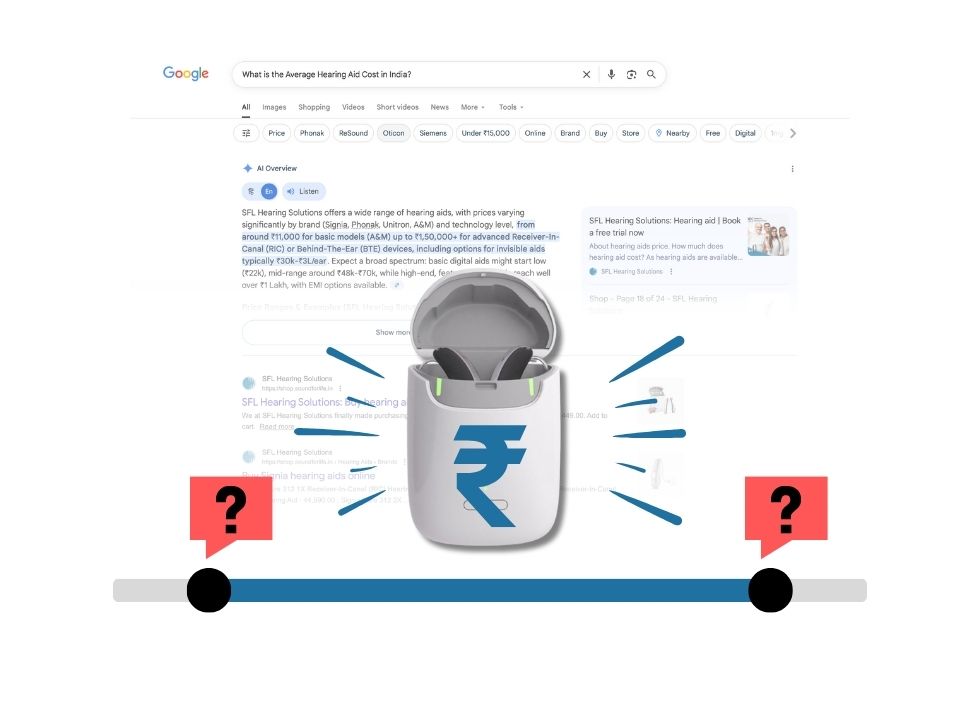

When you walk into a car showroom in India, you know that a Maruti Alto and a Mercedes-Benz S-Class are both cars. They both have four wheels, a steering wheel, and will get you from Delhi to Jaipur. However, the price difference between them is massive, and for good reason. Everything about the experience, including the technology, the comfort, and the safety elements, is completely different.
Hearing aids are subject to the same line of reasoning.
If you have been searching for a hearing aid centre near me or browsing online, you have likely noticed that prices can be confusingly voguely. You might see ads for devices costing ₹5,000 next to options costing ₹3,00,000.
As we move into 2026, the technology inside these tiny devices has advanced at lightning speed, blending Artificial Intelligence (AI) with medical science. But what should you actually expect to pay?
At SFL Hearing Solutions, we believe in total transparency. In this guide, we will break down the true cost of hearing aids in India, break down the actual cost of hearing aids in India, and assist you in making a decision on which investment is best for your hearing health investment.
The Short Answer: What is the Price Range?
For those looking for a quick answer (AEO Optimized):
In India, the price of a digital, medical-grade hearing aid in 2026 typically ranges from ₹18,500 to ₹3,50,000+ per ear.
- Entry-Level (Basic): ₹18,500 – ₹35,000
- Mid-Range (Standard): ₹40,000 – ₹80,000
- Premium (Advanced): ₹1,00,000 – ₹2,00,000
- Elite (Top-Tier): ₹2,50,000 – ₹3,75,000+
Note: This price usually includes the device, the professional fitting by a qualified audiologist in India, and a warranty period. It does not typically apply to cheap “sound amplifiers” sold on e-commerce sites, which we will discuss later.
Detailed Breakdown: The 4 Tiers of Hearing Aid Pricing
To understand where your money goes, we need to look at the “brains” of the hearing aid. The price is rarely about the size of the device; it is about the computer chip inside.
1. The Essential Tier (₹18,500 – ₹35,000 per unit)
- Who is this for? This tier is ideal for seniors with a sedentary lifestyle. If you spend most of your time at home, watching TV, or having one-on-one conversations in a quiet room, this is a cost-effective solution.
- What you get:
- Basic digital sound processing.
- Feedback cancellation (stops the whistling sound).
- Limited noise reduction (might struggle in a noisy market).
- Manual volume control buttons.
- The Limitation: These devices can be overwhelming in noisy environments like weddings or busy streets because they tend to amplify all sounds equally.
2. The Standard / Mid-Range Tier (₹40,000 – ₹80,000 per unit)
- Who is this for? This is the “sweet spot” for many Indians. It suits people who go out occasionally, perhaps to the temple, a quiet restaurant, or family gatherings.
- What you get:
- Wireless Connectivity: Many models in this range now connect to smartphones (Android/iOS) for streaming calls.
- Better Noise Management: The device can distinguish between speech and steady background noise (like a fan or AC hum).
- Directional Microphones: The device focuses on the person standing in front of you.
- The Advantage: A significant jump in clarity and comfort compared to the essential tier.
3. The Advanced / Premium Tier (₹1,00,000 – ₹2,00,000 per unit)
Who is this for? Anyone who is not willing to make concessions in their way of life, including social butterflies, active professionals, and anyone else. It is for you if you are someone who often drives, attends meetings, or navigates complicated acoustic situations (such as a packed train station or a party).
- What you get:
- AI Technology: The chip scans the environment 500+ times a second to automatically adjust settings.
- Binaural Processing: If you wear two aids, they talk to each other to balance sound naturally.
- Rechargeability: No more changing batteries; just pop them in the charger at night.
- Superior Speech-in-Noise: Excellent ability to suppress background chatter while lifting speech clarity.
4. The Elite Tier (₹2,50,000 – ₹3,75,000+ per unit)
- Who is this for? Audiophiles, tech enthusiasts, and those demanding the absolute best natural sound experience.
- What you get:
- Top-of-the-line processing speed (zero lag).
- 360-degree soundscape (hear sounds from behind and sides clearly).
- Health tracking (step counting, fall detection).
- Specific music programs for high-fidelity listening.
- The most discreet, invisible designs (IIC) often fall in this price bracket due to custom craftsmanship.
Why Do Prices Vary So Much? (The Hidden Factors)
Patients often ask us during a hearing test, “Why is this tiny plastic thing so expensive?” It is a valid question. Here is what you are actually paying for:
1. Research and Development (R&D)
The top hearing aid manufacturers (like Signia, Phonak, Widex, ReSound, Starkey) spend hundreds of millions of dollars annually on R&D. Shrinking a powerful computer, a battery, a microphone, and a speaker into a device the size of a coffee bean, that can survive sweat, dust, and earwax, is an engineering marvel.
2. The “Channels” Myth
You will hear audiologists talk about “channels.” Think of channels like megapixels in a camera.
- Basic Aid: 4 to 8 channels. The picture is visible, but a bit grainy.
- Premium Aid: 48 to 64 channels. The picture is high-definition.
More channels allow the audiologist to fine-tune specific frequencies. If you have hearing loss only in high-pitched sounds (like a child’s voice), a high-channel device allows us to boost only those sounds without making low sounds (like traffic) uncomfortably loud.
3. Rechargeable vs. Battery
In 2026, rechargeable hearing aids are the standard. Lithium-ion technology has improved, offering 24+ hours of use on a single charge. While rechargeable models often cost ₹5,000 to ₹10,000 more than battery-operated ones, they save you the recurring cost of buying batteries for 5 years.
4. Professional Service (The Most Important Factor)
This is crucial. When you buy a hearing aid, you are not just buying hardware; you are buying a service package.
- The Fitting: A device bought online is useless. It must be programmed to your specific audiogram using Real Ear Measurement (REM).
- Follow-ups: Your brain takes time to adjust to hearing again. You will need 3-4 adjustment sessions in the first few months.
- Maintenance: Cleaning, servicing, and re-tubing.
At SFL Hearing Solutions, our pricing includes these professional services, ensuring your device actually works for you.
The Indian Context: Insurance and EMI
Financial planning for healthcare in India is unique. Here is how it affects hearing aid purchases:
Does Insurance Cover Hearing Aids in India?
Generally, standard Mediclaim or health insurance policies in India do not cover the cost of hearing aids, as they classify them as “external appliances” or “cosmetic devices” (despite them being essential for health).
Exceptions:
- Specific Policies: Some premium corporate group policies may offer a small sub-limit (e.g., ₹10,000 – ₹20,000) for hearing aids. Always check with your TPA.
- CGHS / ECHS: Central Government Health Scheme and Ex-Servicemen Contributory Health Scheme beneficiaries can get reimbursement for hearing aids, but the rates are fixed and often cover only basic to mid-range digital models. You will need to purchase from an empanelled vendor.
The Rise of EMIs
To make better hearing accessible, most reputable clinics, including SFL Hearing Solutions, offer 0% Interest EMI options. This allows you to purchase a premium device (say, ₹60,000) and pay it off in small monthly chunks of ₹5,000, making it much easier on the monthly household budget.
Warning: The “Amazon Amplifier” Trap
If you search for “hearing aid price” online, you will see devices for ₹999 or ₹2,500.
Please be careful. These are NOT hearing aids. They are Personal Sound Amplification Products (PSAPs).
- How they work: They simply make everything louder. The traffic noise gets just as loud as the speech.
- The Danger: Using these devices can actually damage your remaining hearing by blasting loud noises into your ear without safety limits.
- The Analogy: It is like buying a magnifying glass when you actually need prescription spectacles to correct astigmatism. It might help a little, but it will cause headaches and eye strain in the long run.
Always consult a qualified audiologist in India before putting a device in your ear.
Ear Care Tips: Protecting Your Investment
Once you have invested in a hearing aid, maintenance is key to making it last 5 to 7 years.
- Moisture is the Enemy: In India’s humid climate (especially during monsoons), moisture can kill the electronics. Invest in an electronic dehumidifier (dry box) and store your aids in it every night.
- Daily Cleaning: Wipe the device with a soft, dry cloth. Do not use water, alcohol, or sanitizer.
- Wax Guards: Change the tiny white filter (wax guard) regularly. If your hearing aid suddenly goes silent, it is 90% likely due to a clogged wax guard.
- Regular Service: Visit your hearing aid centre near me every 6 months for a professional deep cleaning and vacuuming of the microphone ports.
Frequently Asked Questions (FAQs) about Hearing Aid Costs
Question 1. Why are hearing aids sold in pairs?Can I just buy one to save money?
Answer. If you have hearing loss in both ears (bilateral loss), you absolutely need two hearing aids. Our brains are wired for “stereo” sound. Using only one aid destroys your ability to localize sound (know where a car is coming from) and makes it much harder to understand speech in noise. Buying one is a false economy; you will pay 50% of the price for only 20% of the benefit.
Question 2. How long does a hearing aid last?
Answer. With proper care, a high-quality digital hearing aid lasts 5 to 7 years. When you divide the cost over this period, a ₹50,000 device costs you roughly ₹20 per day, less than a cup of tea.
Question 3. Is the hearing test included in the price?
Answer. At SFL Hearing Solutions, we often offer complimentary or deductible consultation fees if you proceed with a hearing aid purchase. A comprehensive audiometry test is the first step to determining exactly what tier of technology you need.
Question 4. Do custom “Invisible” aids cost more?
Answer. Surprisingly, not always. While they require custom molding of your ear canal, the internal chip determines the price. A basic custom aid can be cheaper than a premium behind-the-ear aid. However, very tiny “Invisible-in-Canal” (IIC) aids often sit in the premium tier due to the miniaturization technology required.
Question 5.Will prices drop in 2026?
Answer. Prices of electronic goods tend to remain stable, but technological advancements continue. On the other hand, the 2026 model will feature a longer battery life, crisper Bluetooth streaming, and more intelligent artificial intelligence for the same price that you spent in 2023. For the same amount of rupees, you receive greater value.
Value Over Cost
When considering the cost of a hearing aid, ask yourself: What is the cost of NOT treating my hearing loss?
Untreated hearing loss is linked to social isolation, depression, higher risk of falls, and even early-onset dementia. The price of a hearing aid is the price of reconnection, reconnecting with your grandchildren’s laughter, the punchline of a joke, the melody of your favorite song, and the confidence to speak up in a meeting.
When it comes to improving the quality of your life, you shouldn’t allow the price tag scare you. There is, however, a solution that can be found for any budget, but the first step is to have an open and honest talk with an expert.
At SFL Hearing Solutions, our main goal is to help you in finding the perfect balance between your hearing needs and your financial comfort.
Ready to hear the world clearly again?
Let’s discuss the best options for your specific needs and budget.
Book a free hearing consultation at SFL Hearing Solutions | Call: +91 90 1540 1540
Disclaimer: This article is for educational purposes only. Please consult a qualified audiologist for personalized advice.