
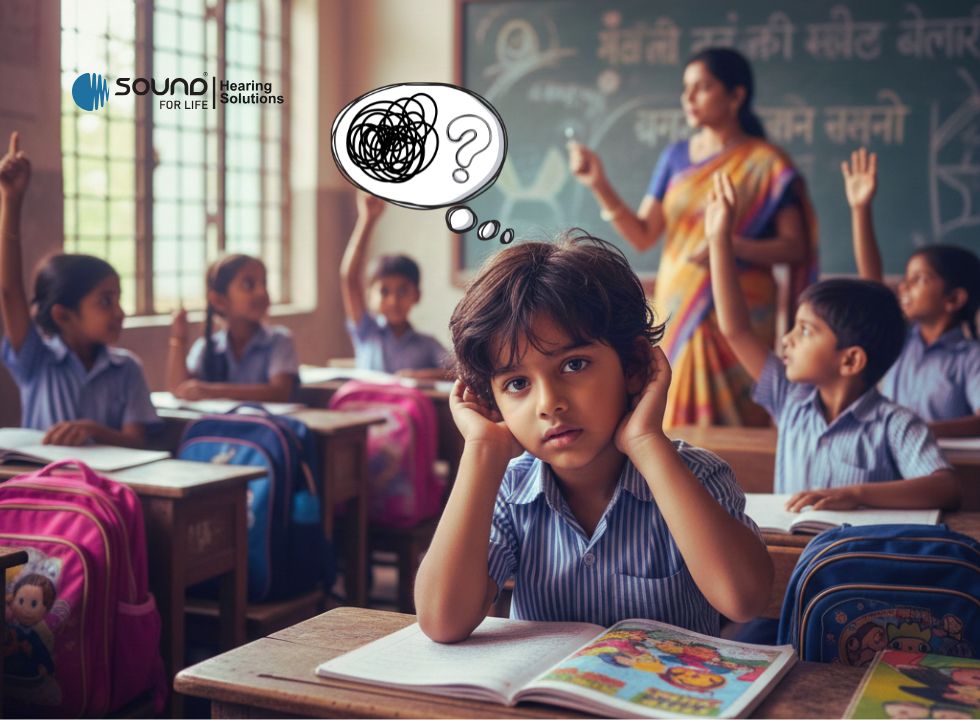

Introduction: The “Inattentive” Student in the Back Row
Imagine a typical classroom in India. The ceiling fan is whirring loudly. Forty students are rustling papers. The teacher is dictating notes from the front of the room.
There is a kid in the back row. Let’s call him Rohan. He seems to be confused. He leans forward to attempt to hear what they’re saying, but it seems muffled. He takes notes from his neighbor’s notepad. The teacher then notes in his journal that Rohan is not paying attention in class and is distracted, so that he can present it to his parents about his behaviour in the class.
A lot of the time, parents read this and think their child is being lazy or playful. They could yell at him or tell him to stop watching TV. But what if Rohan isn’t lazy? What if he simply cannot hear?
In India, childhood hearing loss is often misdiagnosed as ADHD, learning disabilities, or just “bad behavior.” With the rise of noise pollution in our cities and the increasing use of headphones for online classes and gaming, hearing issues in children are on the rise.
As a parent, recognizing the early signs is critical. Early intervention can save a child’s education, social life, and confidence.
At SFL Hearing Solutions, we specialize in pediatric hearing care. This guide will help you identify the subtle red flags of hearing loss in your child and tell you exactly what to do next.
Why is Childhood Hearing Loss Increasing in India?
Before we look at the signs, we must understand the context. Why are we seeing more kids at our clinics?
1. The “Earphone” Generation
Since the pandemic, online classes have become the norm. Indian children are spending hours wearing headphones. Often, these are poor-quality earbuds used at high volumes to drown out household noise. This causes Noise-Induced Hearing Loss (NIHL).
2. Untreated Ear Infections
In India’s humid climate, and with high pollution levels, Middle Ear Infections (Otitis Media) are extremely common. If left untreated (or treated with home remedies like hot oil), these can lead to permanent damage.
3. Environmental Noise
From the honking traffic during the school bus ride to loud music at festivals, Indian children are exposed to decibel levels far above the safe limit of 85dB.
The Academic Signs (School Performance)
Usually, the school is the first place where hearing loss becomes visible. However, it doesn’t look like “deafness”; it looks like “struggling.”
1. Poor Grades in Dictation and Languages
Does your child struggle specifically with dictation? Hearing loss often affects high-frequency sounds first (like ‘s’, ‘f’, ‘th’, ‘sh’). If the teacher says “fish,” the child might hear “fit.” This leads to spelling errors and confusion in language subjects, while they might still do well in Math (which is visual).
2. The “Back Bencher” Drift
A child with mild hearing loss will instinctively try to sit closer to the teacher. If the teacher moves them to the back, and their grades suddenly drop, take it as a warning sign.
3. Exhaustion After School
Listening requires energy. If a child has to strain to hear for 6 hours a day, they will come home mentally exhausted. If your child is unusually cranky or tired after school compared to their peers, they might be suffering from “listening fatigue.”
The Behavioral and Social Signs
Hearing loss isolates a child. Watch for these changes in their behavior at home and on the playground.
1. The “What?” Loop
Does your child constantly say “Kya?” (What?) or “Hain?” (Huh?).
Parents often get irritated and sometimes even shouted at them thinking they are being ignored, “Listen carefully the first time!” But the child is listening; they just aren’t hearing.
2. Turning Up the Volume
If the TV volume is set to 30 for the rest of the family, but your child insists on 50 to watch cartoons, this is a classic red flag. They might also hold tablets or phones very close to their ears.
3. Speaking Too Loudly
We monitor our own voice volume by hearing ourselves. If a child cannot hear themselves clearly, they will speak loudly. You might find yourself constantly telling them to “shush” or “lower your voice” inside the house.
4. Withdrawal from Group Play
Indian playgrounds are noisy. For a child with hearing loss, separating a friend’s voice from the background noise of cricket or tag is impossible. They might start avoiding group games and prefer solitary activities like reading or video games to avoid the frustration.
5. Ignoring You from Another Room
If you call your child from the kitchen and they don’t respond, do not assume they are ignoring you. Test this: walk into the room and call them again. If they jump or look surprised, it means they truly didn’t hear you the first time.
Physical Signs to Watch For
Sometimes, the body gives clues that the ears are in distress.
- Tugging at Ears: Young children might pull or rub their ears if they feel pressure or muffled sound (common in infections).
- Balance Issues: The ear controls balance. If your child is clumsy or falls often, it could be an inner ear issue.
- Mouth Breathing: Chronic blockages in the nose and ears often go together (adenoids). If your child breathes through their mouth, get their hearing checked too.
The Danger of “Wait and See”
In India, we often delay medical visits. “He is just a late bloomer,” or “It’s just wax, let’s put some drops.”
This delay is dangerous.
A child’s brain is developing rapidly. The auditory pathways need stimulation to grow. If a child cannot hear clearly between the ages of 3 and 12, the brain centers for speech and language may not develop correctly. This can lead to permanent speech delays and learning difficulties that are hard to reverse later.
What Should Parents Do? (Step-by-Step)
If you noticed any of the signs above, do not panic. Follow these steps.
Step 1: The “Home Check” (Informal)
Stand behind your child (so they can’t read your lips) and whisper a question. If they don’t respond, try speaking normally. If they still don’t respond, you need a professional.
Step 2: Visit an ENT Specialist
Check for wax blockages or fluid in the ear (glue ear). These are temporary and treatable.
Step 3: See an Audiologist in India
If the ENT says the ears are physically fine, but the hearing issue persists, you need a hearing test.
Search for a “hearing aid centre near me” that specializes in pediatrics. Not all clinics are equipped to test children.
At SFL Hearing Solutions, we use specialized tests like:
- OAE (Otoacoustic Emissions): For younger children.
- Pure Tone Audiometry (Play Audiometry): We turn the test into a game for school-going kids to get accurate results.
Prevention and Ear Care Tips for Kids
Prevention is better than cure. Teach your children these ear care tips:
- The 60/60 Rule: If they use headphones, the volume should be no more than 60%, for no more than 60 minutes a day.
- Say NO to Cotton Buds: In Indian households, ear cleaning is a ritual. But cotton buds push wax deeper. Teach your child that nothing smaller than an elbow goes inside the ear!
- Noise Breaks: If you are at a loud wedding or a Diwali party, give your child’s ears a “break” every hour by going to a quiet room for 10 minutes.
- Hygiene: Ensure they dry their ears after swimming or bathing to prevent “Swimmer’s Ear” (fungal/bacterial infection).
Why Choose SFL Hearing Solutions for Your Child?
Testing a child is different from testing an adult. It requires patience, specialized equipment, and a gentle touch.
- Pediatric Expertise: Our audiologists know how to deal with kids who are scared. We try to make the hearing test seem more like a pleasant activity than a doctor’
- Counseling for Parents: We understand that a diagnosis can be scary for parents. We guide you through the school accommodations, speech therapy options, and technology choices.
- Advanced Solutions: If your child is prescribed hearing aids by an Audiologist, we have a wide range of hearing aids in our clinics. Like our compact hearing aids are built for active kids, water-resistant, tough, and comfortably small. Top manufacturers such as Phonak and Signia offer excellent models.
Frequently Asked Questions (FAQs)
Question 1: Can a child outgrow hearing loss?
Answer: It depends on what caused the hearing loss and what kind it is. If it is caused by fluid or an ear infection (also known as “Glue Ear”), it is usually very transient and may be cured with medicine. But if it’s sensorineural (nerve damage), it’s permanent and you need hearing aids. An audiologist in India can tell you what kind it is.
Question 2: Even if my child passed the newborn hearing screening. Can they still have hearing loss as they grow?
Answer: Yes. This is called “Late-Onset Hearing Loss.” It can be caused by genetics, viral infections, head injuries, or noise exposure as they grow up.
Question 3: How much does a pediatric hearing test cost?
Answer: Diagnostic tests are very affordable. At SFL Hearing Solutions, we provide a wide range of comprehensive testing packages. Early detection is a small investment for your child’s future.
Question 4: Will wearing a hearing aid make my child get bullied?
Answer: Modern hearing aids are tiny, sleek, and come in cool colors. Many look like high-tech earbuds. We also counsel parents on how to speak to teachers to ensure the school environment is supportive, not bullying.
Question 5: Can headphones cause permanent damage?
Answer: Yes. Listening at high volumes for long periods damages the hair cells in the cochlea. This damage is irreversible. Monitor your child’s volume usage strictly.
Trust Your Parental Instincts
You know your child better than anyone. If you feel something is “off,” do not let relatives or neighbors dismiss it as “nautanki” (drama) or lack of focus.
A simple hearing test can give you answers.
If it turns out to be hearing loss, remember: It is not the end of the world. With today’s incredible technology, children with hearing loss go on to become doctors, engineers, musicians, and leaders. They just need the right tools to hear the teacher, hear their friends, and hear the world.
Don’t let silence hold your child back.
If you are worried that your child might have hearing loss or notice any behavioral changes in the child when you call their name, or if they are not responding to any sound, don’t wait.
Book a friendly, non-invasive assessment with our pediatric experts today
Call: +91 90 1540 1540
Disclaimer:
This blog post is for information and learning only. It is not medical advice, a diagnosis, or a treatment plan. Hearing needs are different for each person. If you have questions about your child’s hearing or health, please talk to a qualified doctor, an ENT specialist, or a certified audiologist who can give advice for your child.