
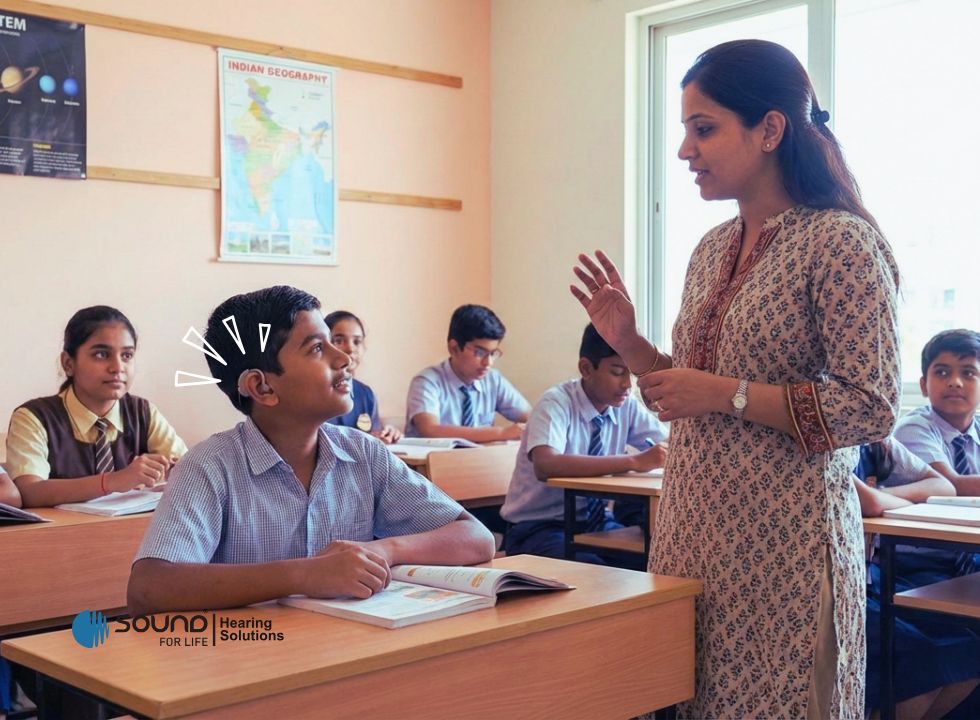

Education is the foundation of a bright future, but for a student dealing with hearing loss, the classroom can sometimes feel like a battlefield of background noise. In India, our classrooms are vibrant, energetic, and let’s be honest, quite loud. From the hum of high-speed ceiling fans to the echoes in large hallways and the bustle of traffic outside, the “acoustic environment” of an Indian school is a unique challenge.
If a child cannot hear the teacher clearly, they aren’t just missing words; they are missing out on social cues, instructions, and the joy of learning. At SFL Hearing Solutions, we know that the right seating arrangement can be the difference between a student who thrives and one who feels left behind.
In this comprehensive guide, we will explore the best classroom seating strategies to support students with hearing challenges, specifically tailored for the Indian educational landscape.
Why Seating Matters More Than You Think
When we talk about managing hearing in school, many parents immediately think of technology. While a high-quality device from a hearing aid centre near me is vital, where the student physically sits is just as important.
Sound follows the “inverse square law.” In simple terms, the further you are from the source (the teacher), the quieter and less clear the sound becomes. For a student with hearing difficulties, “clarity” is usually a bigger problem than “loudness.” Seating isn’t just about being close; it’s about reducing the “signal-to-noise ratio”—ensuring the teacher’s voice (the signal) is much louder than the classroom chatter (the noise).
1. The “Golden Triangle” of Seating
The old-school advice was always: “Sit in the front row.” However, modern audiologists in India now suggest a more nuanced approach. Sitting in the absolute center of the first row can actually be a disadvantage. Why? Because if the teacher moves to the far left or right of the blackboard, the student has to crane their neck, losing the ability to lip-read effectively.
The Preferred Spot: Second or Third Row
Sitting in the second or third row, slightly off-center, is often the “sweet spot.”
- Visual Access: It allows the student to see the teacher’s face, the blackboard, and the expressions of other students who might be asking questions.
- Sound Distribution: Most classrooms have a natural “sound bounce.” Being a few feet back allows the sound to stabilize, reducing the harshness of direct proximity.
2. Managing the Indian “Fan Factor”
We can’t talk about Indian classrooms without mentioning the ceiling fans. In the peak of summer, these fans are essential for comfort, but for a student with a hearing aid, the “whirring” sound can be overwhelming.
- Avoid Direct Placement: Ensure the student is not sitting directly under a noisy or rattling fan. The microphone on a hearing aid is designed to pick up sounds; a noisy fan right above the head can “mask” the teacher’s voice.
- Distance from the “Farrata”: If the classroom uses pedestal fans (farrata fans), the student should be seated at least 6–8 feet away from them.
3. The “Better Ear” Strategy
Most students with hearing loss have a “better ear,” or perhaps they have a unilateral loss (hearing loss in only one ear).
- Orientation is Key: If the student has a better-functioning left ear, they should be seated on the right side of the classroom (from the student’s perspective). This keeps their “good ear” oriented toward the teacher and the center of the room, while the “poorer ear” faces the wall, which acts as a buffer against outside noise.
- Consult an Expert: If you aren’t sure which ear is performing better in a noisy environment, it is time for a professional hearing test. This will provide a clear map of how the child processes sound.
4. Lighting and Lip-Reading
In the world of hearing health, we often say that “we hear with our eyes as much as our ears.” This is especially true for students.
- Avoid “Backlighting”: Ensure the student is not sitting facing a bright window. If the teacher stands in front of a window, their face becomes a dark silhouette, making lip-reading impossible.
- Clear View of the Face: The student should always have an unobstructed view of the teacher’s mouth. In India, many teachers tend to talk while writing on the blackboard. A student with hearing loss needs to be taught (and the teacher needs to be reminded) that “back to the class” means “off the air” for the student.
5. Distance from Noise Sources
Indian schools are often located near busy roads, markets, or construction sites.
- Windows and Doors: If the classroom door leads to a noisy corridor or the window faces a busy street, the student should be seated as far away from these openings as possible.
- The “Back Bench” Problem: Never seat a student with hearing loss at the back. Not only is the sound weaker, but the “reverberation” (echo) from the back wall can turn clear speech into a muddy jumble of noise.
6. The Role of Peer Support (The “Buddy System”)
When applied to the setting of Indian culture, “the buddy system” is extremely effective. Pairing a student with hearing loss with a “hearing buddy” can be a game-changer.
- Note-Taking: The buddy can be of assistance by exchanging notes with the learner in the event that the student fails to pay attention to a particular lesson while configuring their equipment.
- Contextual Cues: If the teacher abruptly changes the subject or the class starts to laugh, the buddy can give the student a brief “one-word” context to help them keep up.
7. Collaborative Planning with Teachers
In most Indian schools, teachers often have to manage large classes of 40–60 students. They aren’t being unkind; they are simply busy. Parents should proactively meet with the school staff to discuss:
- The Seating Plan: Explain why the second row is better than the first.
- Instructional Style: Ask the teacher to call the student’s name before giving an important instruction to ensure they are paying attention.
- Emergency Cues: Ensure the student knows what the fire alarm or school bell sounds like through their device.
Essential Ear Care Tips for Students
While seating is vital, maintaining the “hardware” (the ears and the devices) is equally important. Here are some ear care tips for the school-going age group:
- Avoid Sharp Objects: It’s common for kids to poke pencils or hairpins into their ears during boring lessons. This can cause permanent damage. Educate them on why the ear is “off-limits.”
- Moisture Control: During the Indian monsoon, humidity can damage hearing aids. Use a “dry kit” or a dehumidifier every night to keep the electronics safe.
- Noise Breaks: Classrooms are loud. Encourage the child to spend some time in a quiet library or a peaceful corner during recess to give their brain a “listening break.”
- Regular Check-ups: Children’s ear canals grow and change as they get older, so ear moulds and hearing-aid settings that were perfect a few months ago may no longer fit or work as well. It’s a good idea to visit an audiologist in India about every six months so the ear moulds can be checked and re-shaped if needed, and the hearing aid’s programme and volume can be adjusted to suit your child’s developing listening needs. Regular check-ups keep the device comfortable, prevent feedback or irritation, and make sure your child hears clearly at home and in school and if you notice discomfort, feedback, or a sudden drop in hearing, book an appointment sooner.
Technology to Supplement Seating
Sometimes, even the best seat in the house isn’t enough. This is where assistive technology comes in.
- FM Systems: The teacher wears a small microphone, and their voice is transmitted directly into the student’s hearing aid. This effectively “cancels out” the distance between the teacher and the student, making it feel like the teacher is standing right next to them.
- Modern Hearing Aids: If you visit a hearing aid centre near me, ask about “Directional Microphones.” These are smart features that automatically focus on the person speaking in front of the student while suppressing the noise of the students talking behind them.
Frequently Asked Questions (FAQs)
Question 1. Does seating really make that much of a difference?
Answer: Absolutely. For a student who is hard of hearing, being 10 feet away instead of 20 feet away might make the difference between comprehending 90% of a statement and just 40%.
Question 2. Should my child sit in a U-shaped classroom?
Answer: Yes! If the school allows for U-shaped or semi-circle seating, this is ideal. It allows the student to see the faces of all their classmates during discussions, not just the teacher.
Question 3. What if the teacher moves around a lot?
Answer: If the teacher is a “wanderer,” an FM system is the best solution. If that’s not available, the student should be encouraged to pivot their chair to keep the teacher in their line of sight.
Question 4. How do I explain my child’s seating needs to the school?
Answer: Be direct and helpful. Instead of saying “He can’t hear,” say “He hears best when he can see your face from the second row and isn’t under a fan.” Most Indian teachers are very accommodating when given specific, actionable advice.
Question 5. Can my child play sports with hearing loss?
Answer: Yes! However, ensure they have a secure “sport-clip” for their device. Also, remind them of ear care tips like drying their ears thoroughly after swimming or sweating to prevent infections.
Question 6. Where can I get a professional evaluation for school readiness?
Answer: You should book a hearing test with a certified audiologist in India. They can provide a “classroom acoustics report” that you can share with the school principal.
The Psychological Impact of Good Seating
We must remember that school is about more than just academics; it’s about belonging. A child who is poorly seated and constantly struggling to hear will eventually stop trying. They might become the “quiet kid” or, conversely, act out because they are frustrated.
By optimizing the seating, we remove the “effort” of listening. When listening becomes effortless, the student has more “brain power” left to focus on math, science, and making friends.
We have witnessed many kids go from being timid and unsure to being confident and at the top of their class at SFL Hearing Solutions. This is because their hearing needs were finally satisfied with the perfect mix of technology and atmosphere.
Every child deserves to hear the rustle of a turning page, the clarity of a teacher’s praise, and the laughter of their friends. In the bustling environment of an Indian school, “hope” is not a strategic action.
You are setting your child up for a lifetime of success by following these sitting suggestions, sticking to ear care tips, and making sure they see the doctor often. If you are worried about how well your child is doing in school, the first thing you should do is get them a hearing exam from a specialist.
Book a free hearing consultation at SFL Hearing Solutions | Call: +91 90 1540 1540
Disclaimer: This article is for educational purposes only. Please consult a qualified audiologist for personalized advice.