

Hearing loss is a personal journey, but it is one that millions of seniors in India navigate every day. Whether it is struggling to hear the doorbell ring, missing the punchline of a joke at a family gathering, or having to turn the TV volume up to uncomfortable levels, untreated hearing loss affects more than just your ears, it affects your connection to the world.
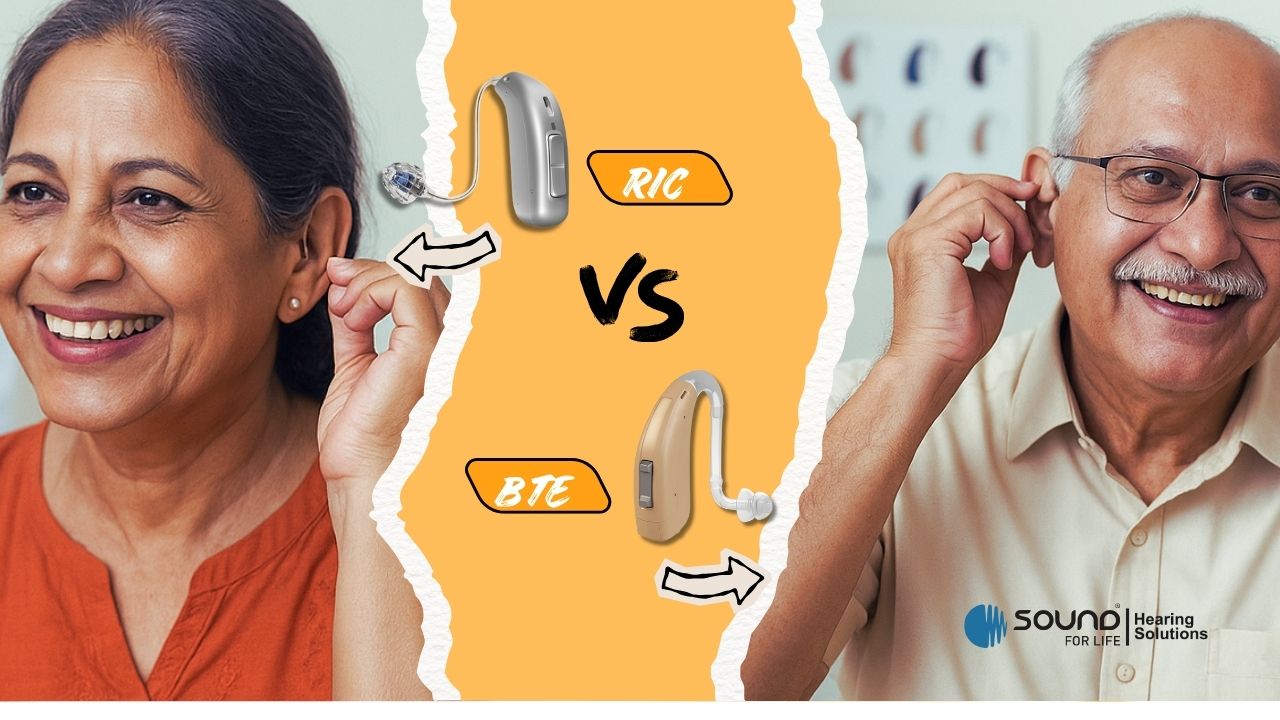
If you have recently taken a hearing test or are helping a parent look for a solution, you have likely encountered two main acronyms: RIC (Receiver-in-Canal) and BTE (Behind-the-Ear).
At a glance, they might look similar, but they function differently and suit different lifestyles. Choosing between them can feel overwhelming. Is the smaller one better? Is the bigger one more powerful? Which one can survive the Indian monsoon humidity?
At SFL Hearing Solutions, we believe an informed patient makes the best decisions. In this guide, we will break down the differences between RIC and BTE hearing aids in a simple way to help you decide which style is the perfect fit for you or your loved ones.
The Basics: What Do These Terms Mean?
Before we compare them, let’s define what these devices actually are.
What is a BTE (Behind-the-Ear)?
The BTE is the “classic” hearing aid style, though modern versions are much sleeker than the beige devices your grandparents might have worn.
- The Body: All the electronic components (microphone, amplifier, battery, and speaker) sit in a durable casing that rests behind the ear.
- The Delivery: Sound is sent from the casing through a clear plastic tube into a custom-made earmold that sits inside your ear canal.
What is an RIC (Receiver-in-Canal)?
The RIC (sometimes called RITE or Receiver-in-the-Ear) is currently the most popular style globally and in India.
- The Body: The microphone and processor sit behind the ear, but the casing is usually much smaller than a BTE.
- The Delivery: Instead of a hollow tube, a thin electrical wire connects the body to a tiny speaker (receiver) that sits directly inside your ear canal.
The Receiver-in-Canal (RIC) Hearing Aid
For many seniors visiting a hearing aid centre near me, the RIC is love at first sight because of its cosmetic appeal. But is it right for you?
The Advantages of RIC
- Invisibility: Because the tube is actually a super-thin wire and the body is tiny, RICs are almost invisible. For seniors who are self-conscious about wearing a device, this is a major plus.
- Natural Sound Quality: RICs often use an “open fit” dome. This allows natural sound (like your own voice) to enter the ear canal alongside the amplified sound. This prevents the “head in a barrel” feeling (occlusion effect).
- Comfort: The tiny dome inside the ear is generally more comfortable than a tight-fitting custom mold.
The Disadvantages of RIC
- Maintenance: Since the speaker is fitted inside the ear, these types of devices are more prone to earwax and moisture. You will need to change the tiny wax guards regularly.
- Handling: The parts are small. If you have severe arthritis or numbness in your fingertips, changing the wax guards or handling the thin wire might be tricky.
The Behind-the-Ear (BTE) Hearing Aid
Don’t rule out the BTE. It is the workhorse of audiology and is often the top recommendation by an experienced audiologist in India for specific cases.
The Advantages of BTE
- Power: BTEs are generally larger, meaning they can hold larger batteries and more powerful amplifiers. If you have severe to profound hearing loss, a BTE is often the necessary choice.
- Durability: Because the speaker is tucked safely behind the ear (not inside the moist ear canal), BTEs are generally more robust and suffer fewer breakdowns due to wax or sweat.
- Easy to Handle: The larger casing and standard batteries are easier to handle for seniors with dexterity issues.
The Disadvantages of BTE
- Visibility: They are slightly larger than RICs. However, modern designs are slim and come in hair-matching colors.
- The “Plugged” Feeling: The custom earmold fills the ear canal, which can make the user feel “plugged up” until they get used to it.
Comparison Table: RIC vs. BTE at a Glance
| Feature | RIC (Receiver-in-Canal) | BTE (Behind-the-Ear) |
| Visibility | Very Low (Discrete) | Low to Medium |
| Hearing Loss Level | Mild to Severe | Moderate to Profound |
| Battery Life | Good (Rechargeable available) | Excellent (Larger batteries) |
| Maintenance | Requires regular wax guard changes | Easier to clean; robust |
| Moisture Resistance | Sensitive (Speaker in ear) | High (Electronics behind ear) |
| Sound Quality | Very Natural (Open fit) | Powerful |
The Indian Context: Factors Specific to Our Environment
When choosing a hearing aid in India, we cannot just look at the spec sheet. We have to look at our environment.Here is how Indian conditions influence the choice between RIC and BTE.
1. Humidity and Monsoon
India is humid. Whether you are in Mumbai, Chennai, or Delhi during the monsoon, moisture is the enemy of hearing aids.
- The Verdict: Traditionally, BTEs handled moisture better.However, premium RICs now come with high IP ratings (water resistance). If you sweat heavily or live in a coastal city, discuss water-resistant coatings with your audiologist.
2.Dust and Pollution
Indian cities can be dusty.
- The Verdict: BTEs are fully sealed, making them slightly more resistant to fine dust entering the electronic components compared to the delicate receiver of an RIC.3. Lifestyle and Family Structure
3. Lifestyle and Family Structure
Indian seniors often live in joint families or active communities.
- The Verdict: If you are frequently in noisy environments (weddings, busy markets, family dinners), you need a device with advanced noise cancellation. Both styles offer this, but an RIC might provide a more “natural” perception of sound in social settings, whereas a BTE provides the raw power needed to cut through the noise if your loss is severe.
4. Dexterity and Assistance
Does the senior live alone, or do they have help?
- The Verdict: If a senior has shaky hands or poor vision and lives alone, the BTE is safer.It is harder to break and easier to put on. If they have support from children or grandchildren to help with maintenance, the RIC becomes a viable option even with dexterity issues.
Which One Should You Choose? A Decision Matrix
Still confused? Here is a simple checklist to help you lean in the right direction before you visit SFL Hearing Solutions.
You should lean toward RIC if:
- You want the device to be as invisible as possible.
- You have mild to moderate high-frequency hearing loss.
- You want the most natural sound for your own voice.
- You are comfortable handling small objects and changing tiny filters.
- Cosmetics are your number one priority.
You should lean toward BTE if:
- You have severe to profound hearing loss (you struggle to hear even loud noises).
- You have chronic ear infections or very “wet” ears (lots of wax/discharge).
- You have trouble feeling sensation in your fingertips or have tremors.
- You want a low-maintenance device that is robust and durable.
- You prefer a device that is easier to insert and remove.
The Role of the Audiologist
While this guide provides a great starting point, you cannot diagnose yourself. Hearing aids are medical devices, not consumer electronics like headphones.
To get the best result, you must consult a qualified audiologist in India.
At SFL Hearing Solutions, we don’t just sell devices; we follow a clinical process:
- Video Otoscopy: We look inside your ear to check for wax or infection.
- Pure Tone Audiometry: We map exactly which frequencies you are missing.
- Lifestyle Assessment: We ask about your daily life. Do you watch TV?Do you attend meetings? Do you visit temples?
- Trial: We let you listen to the difference between RIC and BTE before you buy.
5 Essential Ear Care Tips for Indian Seniors
Regardless of which style you choose, taking care of your hearing health is vital.
- Stop Using Safety Pins and Matchsticks: It is a common habit in India to use available objects to clean ears.Please stop. This pushes wax deeper and risks damaging the eardrum.
- Managing Moisture: If you wear hearing aids, invest in a “Drying Kit” or an electronic dehumidifier. In the Indian climate, putting your aids in a dryer every night can double their lifespan.
- Annual Testing: Hearing changes over time. Schedule a hearing test once a year, even if you think your hearing hasn’t changed.
- Oil is Not a Cure: Putting hot oil or garlic oil in the ear is often considered a traditional home remedy in many Indian households, but it can clog hearing aids and cause fungal infections. Consult a doctor for ear pain.
- Give it Time: When you first get hearing aids, your brain needs time to adjust. Don’t give up after two days.It can take 2 to 4 weeks to get used to the new sounds.
Frequently Asked Questions (FAQs)
Here are answers to the most common questions we get at our clinics.
Question 1: Which hearing aid is better for severe hearing loss, RIC or BTE?
Answer: Generally, BTE (Behind-the-Ear) is better for severe to profound hearing loss. BTEs can accommodate larger speakers and batteries, providing the high gain (volume) needed without causing feedback (whistling sounds).However, some high-power RIC molds are now available that can handle severe loss.
Question 2: Are RIC hearing aids more expensive than BTE?
Answer: Not necessarily. The price usually depends on the technology level (chipset, noise reduction features, Bluetooth) rather than the physical style.At SFL Hearing Solutions, we have both RIC and BTE options available across various budget ranges.
Question 3: Can I wear RIC hearing aids if I have a lot of earwax?
Answer: You can, but it requires more maintenance.Because the receiver sits inside the ear, wax can clog it. If you produce heavy wax, a BTE might be a better low-maintenance choice, or you will need to be very diligent about changing the wax guards on your RIC.
Question 4: Do BTE hearing aids look ugly and old-fashioned?
Answer: No!Modern BTEs are sleek, ergonomic, and come in colors that match skin tones or hair colors. They are considerably more compact than the unwieldy devices of two decades ago.
Question 5: How do I find a reliable hearing aid centre near me?
Answer: Look for clinics that offer access to multiple brands and have qualified audiologists (not just salesmen). Check reviews for after-sales service, as hearing aids require tuning and cleaning. SFL Hearing Solutions is a trusted provider with expert care.
The Best Hearing Aid is the One You Actually Wear
Ultimately, the debate between RIC and BTE isn’t about which device is superior technically, it’s about which device fits your life.
An expensive RIC hearing aid sitting in a drawer because it’s too fiddly to clean is useless. A powerful BTE hearing aid that you refuse to wear because you feel self-conscious is equally useless. The “best” hearing aid is the one that gives you the confidence to participate in conversations again. It’s the one that lets you hear your grandchild’s whisper and the birds chirping in the morning. At SFL Hearing Solutions, we are dedicated to finding that perfect match for you. We understand the Indian lifestyle, we understand seniors, and we understand hearing.
Don’t let confusion keep you from hearing well. We are here to help you choose what’s right.
Take the first step toward better hearing today
Are you ready to experience the difference?
Whether you are considering a Receiver-in-Canal (RIC) or a Behind-the-Ear (BTE) device, the most important first thing you should do is get a professional hearing assessment with a qualified audiologist.
Book a free hearing consultation at SFL Hearing Solutions | Call: +91 90 1540 1540
Disclaimer: This article is for educational purposes only. For personalised advice and treatment, please consult a qualified audiologist.