

Introduction: The “TV Volume” War in Indian Households
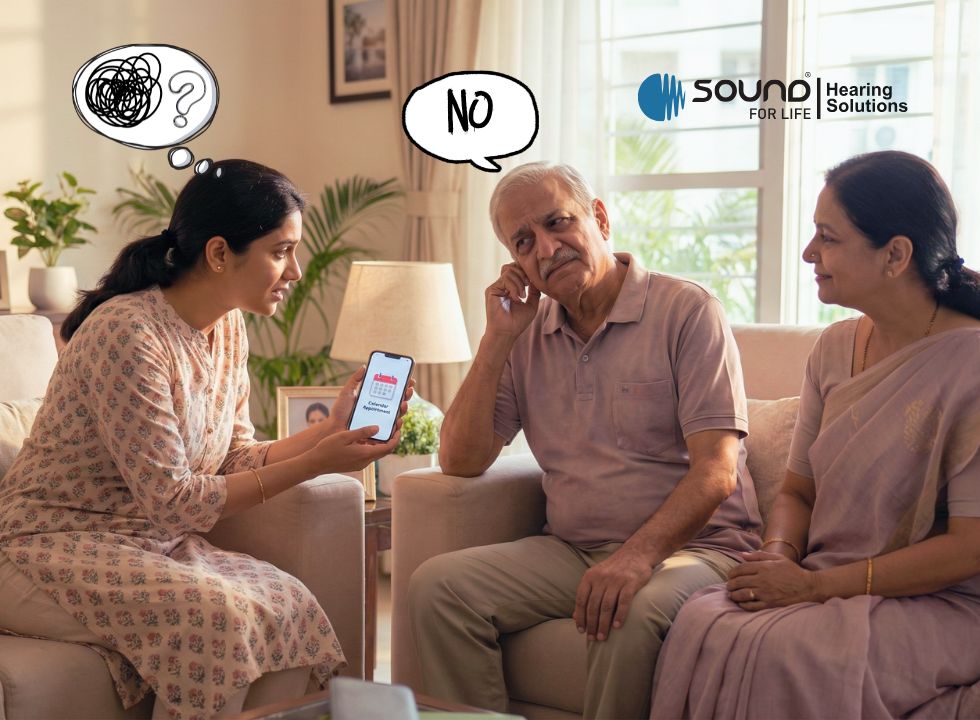
It’s 8:00 PM. The family is gathered for dinner. You try to tell your father about your day at work, but he is staring intently at the news channel. The volume is set to 45. Even the neighbors could probably hear exactly what the news anchor was saying.
When you speak, he doesn’t respond. You say it louder.
“Papa?”
He turns, annoyed. “Why are you shouting? I’m not deaf!”
Does this sound familiar?
If you are a son or daughter in an Indian household, this is a scenario you likely face daily.
You find yourself constantly repeating sentences, acting as a translator between your parents and the rest of the world, or watching them slowly withdraw from family conversations because they just can’t keep up.
We know that deep down, you are worried. You know it’s hearing loss, but they refuse to admit it.
Convincing Indian parents to prioritize their own health, especially something as stigmatized as hearing loss is one of the toughest challenges. They will run to the doctor if you sneeze, but they will ignore their own ailments for years.
At SFL Hearing Solutions, we see this dynamic every day. The good news? You can break through the denial. This guide is designed to help you navigate the emotional, cultural, and logical hurdles to get your parents the hearing test they desperately need.
Understanding the “Why” (The Indian Context)
Before you can convince them, you must understand why they are resisting. In India, many older people resist wearing hearing aids, their reasons are more emotional and cultural than, not just the device itself.
1. The “Log Kya Kahenge” Syndrome (Social Stigma)
To the older generation, losing their hearing can feel like a sign of senility or being “broken.” Wearing a hearing aid can feel like announcing you’re old, and they fear relatives or neighbours will treat them with pity.
2. The “It’s Just Age” Myth
The loss of hearing is considered by many Indian parents to be a normal and unavoidable part of the ageing process, similar to the ageing of hair. They think, “Why should we try to fix something that is already going to happen?” They don’t realize that unlike grey hair, hearing loss affects brain health.
3. The Financial Martyrdom
Indian parents are famous for sacrificing their needs for their children. Even when they can afford it, many Indian parents see a hearing aid as an unnecessary expense or a waste of money, believing it would be better saved for a child’s wedding, a new home, or their grandchildren’s future.
4. Fear of Technology
“If I can’t even handle my smartphone, a small machine in my ear feels impossible to manage.” This fear of gadgetry is a huge mental block for seniors.
The Strategy – How to Approach the Conversation
In India, dealing with elderly parents is not easy. You cannot drag them to an audiologist by force. You have to use strategy. Here is a step-by-step approach.
Step 1: Stop Being the Safety Net
This is the hardest part for caring children. We naturally want to help, so when Papa asks, “Kya bola usne?” (What did he say?), we immediately repeated it, raising our volume.
Avoid doing this.
By constantly translating for them, you are masking the problem. If you continue to fill in the gaps for them, they won’t be able to realise how bad their hearing is. Let them miss a few punchlines in a joke. Let them struggle slightly to hear the doorbell. They need to feel the gap to realize the need.
Step 2: Use the “Grandchild” Card
In Indian families, grandchildren are the ultimate weakness.
If you have kids, use this (gently).
Conversation Starter: “Papa, today Rohan was trying to tell you about his school project, but you didn’t hear him, and he felt ignored. He thinks you don’t want to talk to him.”
Why it works: They can tolerate their own discomfort, but they cannot tolerate the idea of their grandchild feeling unloved.
Step 3: The “Full Body Checkup” Trojan Horse
If you say, “Let’s go for a hearing test,” they will say no.
Instead, say: “Ma, I’ve booked a full body checkup for both of you. Blood, sugar, BP, and ears. It’s a package deal; I’ve already paid, and it’s non-refundable.”
Once they are at the clinic, the audiologist takes over.
Step 4: Focus on Safety, Not Hearing
Indian cities are chaotic. Traffic comes from all directions.
The Argument: “Ma, it’s not about conversation. It’s about safety. Yesterday you didn’t hear the scooter honking behind you. I’m scared for your safety when you go for your evening walk.”
This shifts the conversation from “vanity” to “security.”
The Medical Truth (The Logic)
Sometimes, emotional appeals don’t work. You need cold, hard medical facts. Indian parents respect doctors. You need to present the consequences of untreated hearing loss.
1. The Brain Connection (Dementia)
Multiple studies have linked untreated hearing loss to a higher risk of dementia and Alzheimer’s.
- Explain it simply: “Papa, ears are just the microphone. The brain is the recorder. If the microphone is broken, the brain stops getting signals and starts to forget how to process sound. We want to keep your brain sharp.”
2. Social Isolation and Depression
When hearing requires effort, people get tired. They stop going to weddings, they stop chatting with neighbors, and they withdraw into a shell. This leads to rapid emotional decline.
3. The “Auditory Deprivation” Effect
Explain that the longer they wait, the harder it is to treat. If the auditory nerve isn’t stimulated for years, it can atrophy (wither away). A hearing aid 5 years from now might not work as well as it would today.
Debunking the Myths
Your parents likely have an image of hearing aids from the 1990s, big, beige, whistling bananas that sit behind the ear.
You need to show them the latest reality.
Myth: “It looks ugly.”
Reality: Show them pictures of Invisible-in-Canal (IIC) aids. Tell them, “These go inside the ear. No one will know you are wearing them.”
Myth: “It will whistle and make noise.”
Reality: Modern digital hearing aids suppress background noise and focus on speech. They are smart computers, not just amplifiers.
Myth: “It’s too hard to use.”
Reality: The hearing aids of today are equipped with cutting-edge technology and operate primarily on their own. You put them in, and they adjust themselves. Some are even rechargeable, so no fiddling with tiny batteries.
How SFL Hearing Solutions Can Help
Searching for a “hearing aid centre near me” can be overwhelming. With SFL Hearing Solutions, you’ve got a caring partner focused on restoring your hearing and confidence.
We understand the Indian family dynamic. We know that bringing a stubborn parent to a clinic is a task.
The Game Changer: Home Visits
If your parents refuse to go to a clinic, we bring the clinic to them.
Our qualified audiologists can visit your home with portable, state-of-the-art diagnostic equipment.
Why this helps: Your parents are in their comfort zone (their own sofa). The experience is more comparable to a straightforward health check than it is to a visit to the hospital, which avoids the inconveniences of traffic and the lengthy queues.
The “Trial” Period
We offer trials. We tell hesitant parents, “Just try it for a few days. If you don’t like it, we won’t force you.”
Usually, once they experience the clarity of sound, hearing the birds chirp or the TV at volume 15, they never want to give it back.
Essential Ear Care Tips for Seniors
While you take time to convince them, make sure they follow these simple ear care tips to avoid further hearing damage.
- No Oil/No Pins: It is an old Indian habit to put warm oil in the ear or use a safety pin to clean wax. Strictly forbid this. This is the main reason for ear infections and eardrum perforations.
- Manage Diabetes: High blood sugar damages the blood vessels in the ear. Keeping diabetes in check is crucial for hearing health.
- Hypertension Control: Manage blood pressure, high bp can cause tinnitus (ringing in the ears). Regular monitoring is essential.
- Dry Ears: Ensure they dry their ears thoroughly after a bath to prevent fungal infections, which are common in India’s humid climate.
Scripting the Conversation
Can’t think of what to say? Here are a few scripts you can use today.
The “I Miss You” Approach:
- “Papa, I miss hearing your stories. Would you like to talk for a while?” I feel like we don’t have deep conversations anymore because I have to shout, and it ruins the mood. I want my chatting partner back. Can we please just check your hearing?”
The “Technology” Approach (For tech-savvy parents):
- “Ma, did you know new hearing aids can connect to your iPhone? You can stream your WhatsApp calls and YouTube bhajans directly into your ears. It’s like having invisible AirPods!”
The “Doctor’s Orders” Approach:
- “I spoke to an audiologist in India today. They said that your ringing in the ears (tinnitus) can be treated. We don’t have to suffer in silence. Let’s just go for a consultation.”
Frequently Asked Questions (FAQs)
Question 1: My father refuses to go to a doctor. Can I do a test at home?
Answer: Yes! SFL Hearing Solutions offers comprehensive home visits. We bring the audiometer to your house. This is often the best way to bypass their resistance to visiting a clinic.
Question 2: Are hearing aids very expensive in India?
Answer: There is a wide range. Prices start from economical basic models to premium technology. Think of it as an investment, like buying a good pair of spectacles. It’s a one-time cost for 5-7 years of better living.
Question 3: Will wearing a hearing aid make my hearing worse naturally?
Answer: No, this is a myth. Wearing a hearing aid actually keeps the auditory nerve active and healthy. It prevents the brain from “forgetting” sounds.
Question 4: How long does a hearing test take?
Answer: A diagnostic Pure Tone Audiometry (PTA) test usually takes about 20 to 30 minutes. It is painless and non-invasive.
Question 5: My mother has only mild hearing loss. Does she really need a machine?
Answer: Yes. Treating hearing loss early (at the mild stage) is much more effective than waiting until it becomes severe. It prevents cognitive decline and makes adapting to the device much easier.
Do It For Their Quality of Life
Your parents spent their lives ensuring you had the best health, the best education, the best food, the best opportunities. Now, it is your turn to ensure they have the best quality of life in their golden years.
Hearing loss is isolating. It turns vibrant, social people into silent observers. Don’t let that happen to your parents.
It might be an awkward conversation. They might get angry. They might say no the first five times. But keep trying. The moment you see their face light up because they heard their grandchild whisper “I love you” that moment will be worth all the effort.
Don’t wait for silence to take over.
Need help convincing them?
Let our experts talk to them. Book a consultation or a home visit today.
Call: +91 90 1540 1540
Disclaimer:
This blog article is not medical advice; it is simply meant to provide you information. Everyone’s hearing health is different. Always consult a certified audiologist or ENT specialist for a professional diagnosis and treatment plan that is right for you.