
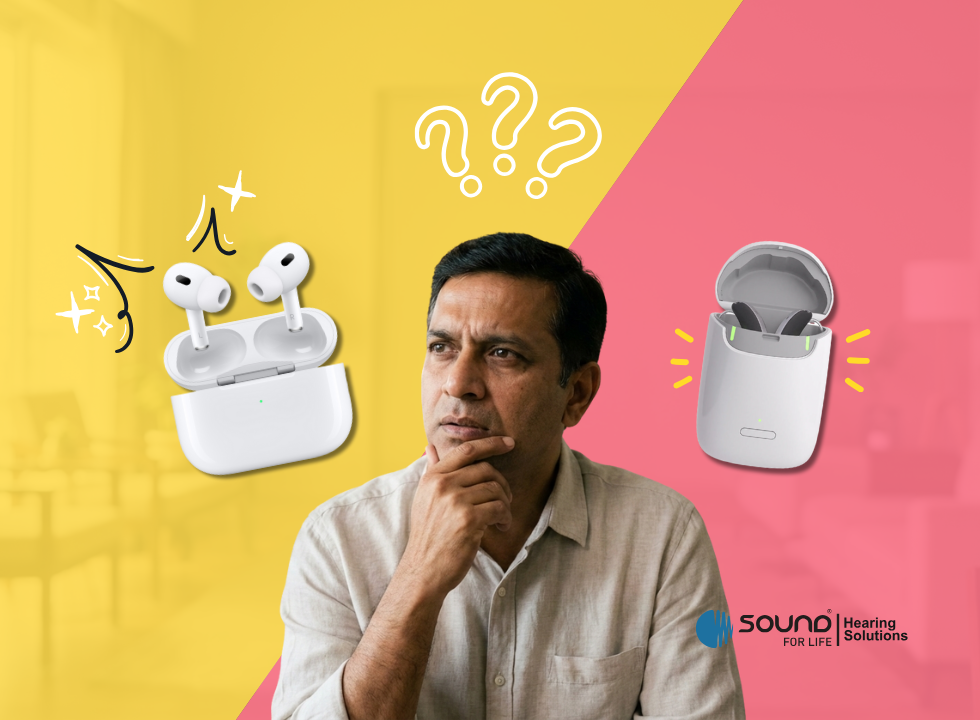

If you have been following the tech news lately, you might have heard the buzz: Apple has turned its AirPods Pro 2 into clinical-grade hearing aids.
For millions of people in India dealing with hearing loss, this sounds like a dream come true. Why spend lakhs on medical devices when a pair of ₹24,900 earphones can do the job? It’s a valid question, and one that is shaking up the audiologist community from Delhi to Bangalore.
But is it too good to be true? Can a consumer electronic device really compete with a prescription hearing aid that has been fine-tuned by a doctor?
Here is everything you need to know about Apple AirPods Pro versus prescription hearing aids, and which one is actually right for your ears.
The Game Changer: How Apple Entered the Arena
In late 2024, Apple released an update to the software that enabled the AirPods Pro 2 to perform the functions of over-the-counter (OTC) hearing aids that were approved by the FDA.
The process is shockingly simple. You put the AirPods in your ears, take a 5-minute hearing test directly on your iPhone, and voila the phone programs the earbuds to boost the specific frequencies you are struggling to hear. You can even upload a professional audiogram from an audiologist in India if you have one.
Round 1: Streaming & Sound Quality
Winner: Apple AirPods Pro 2
If your primary goal is to listen to Arijit Singh or watch Netflix on your commute, Apple takes the crown hands down.
- The “Closed” Advantage: AirPods use silicone tips that completely seal off your ear canal. This traps the bass and low-frequency sounds inside, making music sound rich, full, and immersive.
- The Prescription Trade-off: Most prescription hearing aids use “open domes” (tiny silicone umbrellas with holes). These are designed to let natural sound in, but they unfortunately let streaming bass leak out. While music sounds good on modern hearing aids, it rarely has that thumping bass of a high-end earbud.
The Verdict: If you are a music lover first and a hearing aid user second, the AirPods are unbeatable for media consumption.
Round 2: Speech in Noise (The “Indian Wedding” Test)
Winner: Prescription Hearing Aids (By a Mile)
This is the most critical category. Hearing well in a quiet room is easy. Hearing your auntie speak over the noise of a generator, traffic, or a crowded baraat is the real challenge.
According to independent lab testing by Hear Advisor, the Apple AirPods Pro 2 struggled significantly in noisy environments, scoring a mere 0.8 out of 5 for speech-in-noise performance initially. Even with fine-tuning, they couldn’t catch up to medical devices.
Why Prescription Aids Win:
- Open Domes vs.Closed Tips: Remember those open domes?They allow natural sound to enter your ear, mixing with the amplified sound for a clearer speech signal.
- Advanced AI: Prescription aids from brands like Phonak, Signia, or Widex use dedicated AI chips trained to aggressively suppress background noise while enhancing speech. They can “zoom in” on a person speaking in front of you.
- Score: Premium prescription hearing aids often score 4.6 out of 5 in the same lab tests.
The Verdict: If you want to understand conversations in the chaotic noise of an Indian city, prescription hearing aids are the only serious choice.
Round 3: The “Own Voice” Problem (Occlusion)
Winner: Prescription Hearing Aids
Have you ever stuck your fingers in your ears and talked? Your voice sounds booming, hollow, and unnatural. This is called the Occlusion Effect.
- The Apple Problem: Because AirPods seal your ear canal tightly to cancel noise, they trap your own voice inside your head. Many users find it annoying to carry on a conversation because they sound like they are speaking from inside a barrel.
- The Audiologist Solution: A qualified audiologist in India will fit you with vented domes or custom molds that release this pressure. You hear your own voice naturally, just as you did before you had hearing loss.
Round 4: Battery Life & Practicality
Winner: Prescription Hearing Aids
Imagine you are at a family function. The festivities started at 10 AM and will go on until midnight.
- AirPods Pro 2: You will get about 5 to 6 hours of battery life on a single charge. If you use them as hearing aids, they will die before tea time. You then have to take them out, put them in the case, and wait for them to recharge, leaving you deaf to the world in the meantime.
- Prescription Aids: Modern rechargeable hearing aids offer 24+ hours of continuous use, including several hours of streaming. You put them in when you wake up, and you take them out when you sleep.
The Verdict: For all-day wear, AirPods are simply not practical yet.
Round 5: Social Etiquette & Stigma
Winner: It’s Complicated
This is a unique cultural battle.
- The “Rude” Factor: While AirPods are socially acceptable, wearing them while talking to your boss or your mother-in-law often signals, “I am listening to music, not you.” It can appear disrespectful or disengaged.
- The “Invisible” Factor: Modern prescription hearing aids are often smaller and more discreet than white plastic earbuds. RIC (Receiver-in-Canal) models hide behind your ear, and custom IIC (Invisible-in-Canal) models sit deep inside, completely unseen.
The Verdict: If you want people to know you are engaged in the conversation, a discreet prescription device is often more polite than wearing prominent white earbuds.
The Audiologist’s Verdict: Who Should Buy What?
So, are the AirPods Pro 2 “better” than hearing aids? The answer depends entirely on YOU.
Buy the Apple AirPods Pro 2 if:
- You have Mild Hearing Loss: They are FDA-cleared only for mild to moderate perceived loss.
- You are on a Budget: At ₹25,000, they are an incredible entry point compared to the ₹40,000+ starting price of medical devices.
- You Need a Backup: They make an excellent “Plan B” if your main hearing aids are being repaired.
- You Mostly Stream: If you spend 80% of your day listening to podcasts or music and only need occasional hearing help.
Visit a Hearing Aid Centre Near Me if:
- You Have Moderate to Severe Loss: AirPods simply cannot provide the power or “gain” needed for more significant hearing issues.
- You Want to Hear in Noise: If you struggle in restaurants, meetings, or family gatherings, you need the advanced noise processing of a prescription device.
- You Need All-Day Battery: 6 hours is not enough for a full life.
- You Value Professional Care: A device is only as good as the programming. At SFL Hearing Solutions, we use Real Ear Measurement (REM) to scientifically verify that your hearing aids are delivering exactly the prescription your brain needs, something an iPhone app cannot perfectly replicate.
Essential Ear Care Tips for Headphone Users
If you decide to use AirPods as your primary device, follow these tips to protect your remaining hearing:
- Clean them Daily: Earwax can clog the mesh quickly, reducing sound quality.
- Take Breaks: Due to the fact that they enclose the ear, moisture might accumulate. Remove them once every hour to allow your ear canals to air and to aid in the prevention of fungal infections, which are a prevalent problem in the humid climate of India.
- Don’t Over-Amplify: Be careful not to crank the volume too high to compensate for outside noise.
Frequently Asked Questions (FAQs)
Question 1: Can I use AirPods Pro 2 if I have an Android phone?
Answer: No. The hearing aid feature is locked to the Apple ecosystem. You need an iPhone or iPad running the latest iOS (iOS 18 or later) to take the hearing test and set up the feature.
Question 2: Are AirPods Pro 2 a replacement for real hearing aids?
Answer: For most people with diagnosed hearing loss, no. They are a “bridge” device. They are great for people who are not quite ready for hearing aids but need a little help, or for situational use. They do not replace the medical customization of a prescription device.
Question 3. Do I still need a hearing test if I have AirPods?
Answer: Yes! While the Apple test is good, it is a screening tool. It checks “at-threshold” hearing. A professional audiometry test at a hearing aid centre near me checks for bone conduction (type of loss), speech discrimination (brain processing), and ear health (wax, infection). An app cannot diagnose why you have hearing loss.
Question 4. Can SFL Hearing Solutions help me set up my AirPods?
Answer: While we specialize in medical-grade devices, we can perform a professional audiogram that you can upload to your iPhone for a more accurate AirPod setup. We believe in better hearing, whatever the method!
Question 5. Why do prescription hearing aids cost so much more?
Answer: You are paying for miniaturized medical technology that lasts 5-7 years, all-day battery life, and most importantly, the professional service included in the price (fitting, follow-ups, cleaning, and warranty).
Don’t Guess with Your Senses
Apple has done something incredible: they have started a conversation about hearing health. If the AirPods Pro 2 helps you realize what you’ve been missing, the birds chirping, the kettle whistling, the whispers of your grandchildren, then they are a success.
But do not settle for “good enough” if you are struggling to connect with the world.
Your hearing is a vital sense that connects you to your loved ones. Whether you choose the high-tech route of Apple or the medical precision of a prescription device, the most important step is taking action.
If you are unsure where your hearing stands, don’t rely on a phone app alone. Get a professional baseline check-up.
CTA: Book a free hearing consultation at SFL Hearing Solutions | Call: +91 90 1540 1540
Disclaimer: This article is for educational purposes only. Please consult a qualified audiologist for personalized advice.