
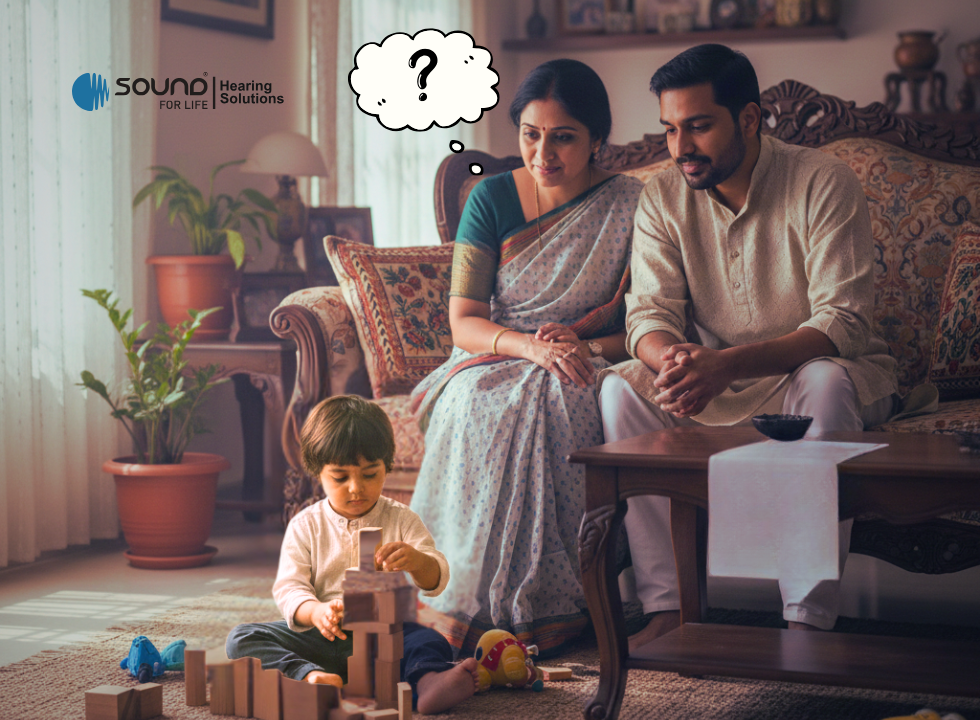

There is no sound sweeter to an Indian parent’s ears than their child’s first “Amma,” “Papa,” or “Ma.” We eagerly await the day our child will start babbling, reciting nursery rhymes, or simply telling us what they want for lunch.
But for some parents, that day is delayed. You observe other children of the same age engaging in conversation at the park, while your child uses gestures or sounds to communicate. Naturally, concern arises. Family members might provide reassurance: “Do not be concerned; boys tend to speak later,” or “His uncle did not speak until he was four, and he is now a doctor.” “While these stories are comforting, they can sometimes be dangerous.
One of the most common, yet overlooked, reasons for speech delay is hearing loss.
If a child cannot hear well, they cannot learn to speak well. It is that simple.
At SFL Hearing Solutions, we understand the anxiety that comes with developmental delays. We are here to tell you that if your child isn’t talking yet, it is not your fault but it is time to act.
In this guide, we will explore the critical link between hearing and speech, how screening works in India, and why early intervention is the key to a bright future.
The Connection: Why Ears are the Gateway to Speech
To understand why your child is not talking, you will first have to understand how language is learned.
Imagine, you are trying to learn a new language, like French or German, but you are listening to the lessons through a broken radio filled with static. You might be able to pick up a sound now and then, but you won’t be able to put together clear words or sentences.
This is what life is like for a child with untreated hearing loss.
From the moment a baby is born (and even in the womb), their brain is a sponge. They are soaking up sounds of the pressure cooker whistle, the doorbell, your lullabies, and the chatter of a busy Indian household.
These sounds form “neural pathways” in the brain. If the ears do not send clear sound signals to the brain, the brain’s “language center” does not get the data it needs to develop.
The Golden Rule: A child must hear speech to learn speech.
The “Indian Context”: Milestones and Red Flags
In India, our homes are often noisy. We have joint families, constant traffic noise, and loud festivals. Sometimes, this background noise can mask a child’s hearing issue. You might think the child is just distracted, when in reality, they didn’t hear you.
Here is a checklist of milestones. If your child is missing these, it is time to book a hearing test.
Newborn to 3 Months
- The Startle Reflex: When a very young infant hears a sudden loud noise, such a dish dropping or a dog barking, they may jump, flinch, or blink. Observe whether they respond to loud noises and then calm down again.
- Soothing by voice: Pay attention to how your baby reacts to your voice. When newborns hear a voice they know, they often settle down, breathe more slowly, or cease screaming. They can relax by singing softly or chatting to them gently.
- Coo-ing and early sounds: In these first weeks and months babies often make soft vowel sounds like “oo” or “aa.” They may coo back when you talk to them. These small sounds are the start of speech and show they are listening and trying to communicate.
4 to 6 Months
- Looking for sounds (tracking): At this age babies often move their eyes or turn their head to find where a sound comes from. They might turn their head or move their eyes towards the sound if you clap or call their name from the other side.
- Interest in noisy toys: Rattles, squeakers, or toys that make a sound usually catch their attention. They may stare at the toy, smile, or try to reach for it. This shows they notice and enjoy noises.
- Reacting to music: By this time, the babies often start to pay attention to music or sounds that excite them. They may quiet down, move their arms or legs, or watch the source of the music. Music helps them learn rhythm and language patterns.
7 to 12 Months
- Babbling and practice speech: This is a very important stage. Babies will try to replicate sounds and combine consonants and vowels together. For example, they could say “ba-ba,” “da-da,” or “ma-ma.” They practise creating words by saying these sounds over and over.
- Recognition: By this age, many newborns will turn their heads or gaze when you call their name. This suggests that kids are learning to connect sounds with individuals.
- Getting the meaning of simple words: Babies start to pay attention to brief words like “No,” “Bye-bye,” and “Come.”When you speak these phrases, they could stop, stare, or do anything, which shows they grasp fundamental concepts.
1 to 2 Years (The Critical Zone)
- First real words: Between about 12 and 24 months most children begin to say clear single words for example, like, “mama,” “ball,” “dog,” or “water.” These first words are important steps toward full speech.
- Following simple instructions: A child in this age range should be able to follow short, clear commands without you using lots of gestures, for example, “Give me the ball” or “Come here.” They may need the phrase repeated once or twice.
- Enjoying listening (or losing interest): Many toddlers like being read to, listening to short stories, or hearing songs. If a child pays attention, points at pictures, or turns pages, these are good signs. If they lose interest very quickly in sounds or stories, watch for other signs of delayed listening or speech and talk to your health worker or audiologist for advice.
- Red Flag: If your child is 18 months old and has no clear words, or if they rely heavily on gestures (pointing/pulling) to get what they want, you need to consult an audiologist immediately.
Why the “Wait and Watch” Approach is Risky
In many Indian cultures, there is a stigma associated with medical testing for children. Elders often advise parents to “wait and watch.”
While well-intentioned, this advice ignores biology.
There is a concept called the Critical Period. The first 3 years of life are when the brain is most “plastic” (moldable). This is the prime window for learning language.
If a child has hearing loss and we wait until they are 4 or 5 years old to treat it:
- The Brain Reorganizes: The part of the brain reserved for hearing starts to get taken over by vision.
- The Gap Widens: A 4-year-old with untreated hearing loss is not just 4 years behind in language; they are struggling to catch up on cognitive and social skills too.
- School Struggles: They may be labeled as “slow learners” or “naughty” in school because they can’t follow instructions, when the real issue is simply that they can’t hear the teacher.
Early detection is not about labeling your child; it is about empowering them.
Hearing Screening in India: Safe, Painless, and Fast
Many parents fear that a hearing test will be painful or traumatic for their baby. This is a myth. Modern pediatric hearing screening is non-invasive and often done while the child is sleeping.
When you visit a hearing aid centre or a specialized clinic like SFL Hearing Solutions, here are the two most common tests that is perform:
1. OAE (Otoacoustic Emissions) – “The Echo Test”
How it works: We place a tiny, soft probe (like a small earbud) just inside the baby’s ear canal.It plays a soft clicking sound.
What we look for: A healthy inner ear (cochlea) “echoes” sound back. The machine measures this echo.
The Experience: It takes 2 minutes.The baby feels nothing.
The Result: “Pass” or “Refer.” (Refer means we need to check again; it doesn’t confirm hearing loss yet).
2. BERA / ABR (Brainstem Evoked Response Audiometry) – “The Sleep Test”
How it works: If a child fails the OAE, or if they are high-risk, we do a BERA. We place small stickers (electrodes) on the baby’s head and play sounds through earphones.
What we look for: We measure the electrical waves the brain sends in response to sound.It tells us exactly how much the child can hear.
The Experience: The child must be asleep.It is completely painless.
The Result: This gives us a definitive diagnosis of the degree of hearing loss.
Causes of Hearing Loss in Indian Children
Why does this happen? Parents often blame themselves, thinking they did something wrong during pregnancy.
Please know that in most cases, it is not your fault.
Here are common causes we see in India:
- Genetics: Hearing loss can run in families. In communities where consanguineous marriages (marrying cousins/relatives) are common, the risk of genetic hearing loss is higher.
- NICU Stays: Babies who had severe jaundice, low birth weight, or lacked oxygen at birth are at higher risk.
- Infections: During pregnancy the mother contracted Rubella (German Measles) or Cytomegalovirus (CMV).
- Ear Infections (Otitis Media): This is very common in India due to excessive dust and humidity. Fluid accumulates behind the eardrum, resulting in transient hearing impairment. If this temporary hearing loss is left untreated, it can affect speech development.
- Noise: Exposure to excessively noisy sounds (such as firecrackers and loudspeakers) can harm the hearing of young individuals.
What If My Child Has Hearing Loss? The Next Steps
If the tests confirm hearing loss, take a deep breath. It is natural to grieve the “perfect” childhood you imagined. But remember: Deafness is not a destiny of silence.
With today’s technology, children with hearing loss can attend mainstream schools, speak clearly, and achieve their dreams.
Step 1: Fitting Hearing Aids
The sooner, the better. Babies as young as 4 weeks old can be fitted with hearing aids.
- Pediatric Hearing Aids: These are robust, water-resistant, and come in fun colors. They are designed to stay on active little ears.
- Safety: They have tamper-proof battery doors so the child can’t swallow the battery.
Step 2: Speech and Language Therapy
Hearing aids open the door, but therapy helps the child walk through it. An Auditory-Verbal Therapist (AVT) teaches the child how to listen to the new sounds and turn them into words.
Step 3: Cochlear Implants
For children with profound hearing loss who do not benefit from hearing aids, Cochlear Implants are a miracle of modern medicine. They bypass the damaged part of the ear and stimulate the hearing nerve directly. SFL Hearing Solutions can guide you through this process if needed.
5 Essential Ear Care Tips for Indian Kids
Prevention is always better than cure. Here are quick tips for parents:
- No Oil in Ears: It is a traditional Indian remedy to put warm oil in the ear for pain. Please avoid this. It can cause fungal infections or block the ear, making hearing worse.
- Avoid Earbuds: Never use cotton swabs (earbuds) to clean a child’s ear. You push the wax deeper. Ears are self-cleaning.
- Treat Colds Quickly: In children, the tube connecting the nose and ear is short. A simple cold can quickly turn into an ear infection.
- Volume Control: Limit the volume on iPads/phones if your child uses headphones.
- Screening at Birth: If your hospital did not do a hearing screen when your baby was born, get it done now. It is never too late to check.
Frequently Asked Questions (FAQs)
Here are answers to the questions anxious parents often ask us.
Question 1: My child reacts to loud noises but doesn’t speak. Can he still have hearing loss?
Answer: Yes.This is possible. He might have “High-Frequency Hearing Loss.” This means he can hear the low rumble of a truck or a door slamming, but he cannot hear the high-pitched sounds of speech like “s”, “f”, or “th.” Without these sounds, speech sounds like mumbling, making it hard to learn words.
Question 2: Is the hearing test expensive?
Answer: Tests like OAE that check for problems are fairly cheap. Tests like BERA that help doctors figure out what’s wrong with your child cost a little extra, but they’re worth it for the long term. Testing is not very expensive compared to the expense of speech or education treatment later on.
Question 3: Will my child have to wear a hearing aid forever?
Answer: It depends on the type of hearing loss. If it is “conductive” (due to fluid or wax), it might be curable with medicine or minor surgery. If it is “sensorineural” (nerve damage), hearing aids or implants are permanent solutions.
Question 4: How do I find a good audiologist in India for kids?
Answer: Pediatric audiology is a specialty. You need a clinic that has experience with children, patience, and the right equipment (like pediatric visual reinforcement audiometry). SFL Hearing Solutions has specialized protocols for children.
Question 5: Can a child with hearing aids go to a normal school?
Answer: Absolutely! The vast majority of children who get treated early (before age 3) attend mainstream schools, go to college, and live completely normal lives.
Action is Love. If you are reading this post, it is because you love your child and want the best for them.
The silence in your home doesn’t have to be permanent. But the clock is ticking. Every day a child goes without hearing sound is a day of lost brain development.
Do not let fear or social stigma hold you back. A hearing test is quick, painless, and the first step toward hearing your child say “I love you.”
At SFL Hearing Solutions, we treat every child with special care and compassion like our own. We employ the most up-to-date tools to make accurate diagnoses and treat them with kindness. We are here to help you from the first assessment to the first word.
Let’s break the silence together.
Is Your Child Meeting Their Speech Milestones?
Don’t wait and watch. Peace of mind is our utmost priority and we are just a phone call away.
CTA: Book a free hearing consultation at SFL Hearing Solutions | Call: +91 90 1540 1540
Disclaimer: This article is for educational purposes only. Please consult a qualified audiologist for personalized advice.