
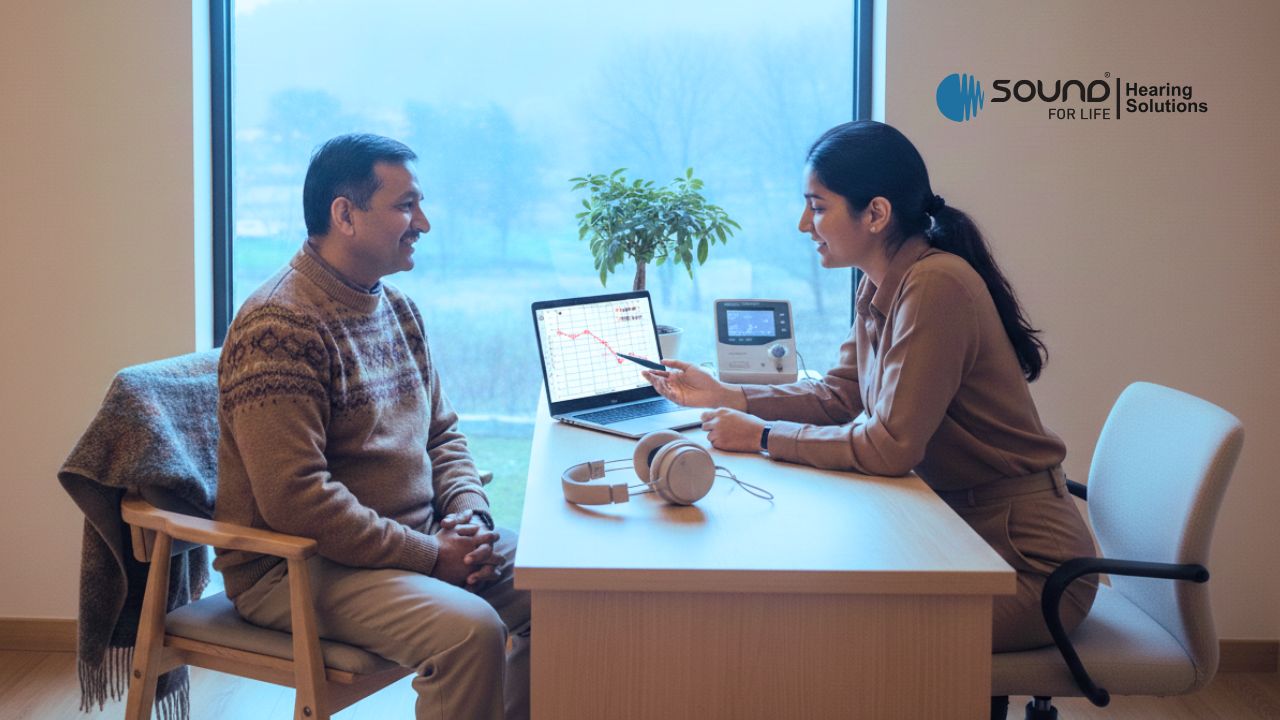

As the year comes to a close, India goes through a time of deep thought and preparation. We look over our financial portfolios, check on how well our kids are doing in school, and finish our tax returns. Before the next financial cycle starts, it’s a good time to set objectives and make big choices.
One important thing that is sometimes missed out of this yearly checkup is your hearing health.
Hearing loss is a secret problem for millions of individuals in India that affects their social lives, mental clarity, and general health.People often say “it’s just old age,” but putting off getting help until it’s a crisis is bad for you and your family.
We at SFL Hearing Solutions think that the best time to schedule a professional hearing test with a certified audiologist in India is towards the end of the year. This easy-to-read book will explain why this proactive planning is good for both your health and your wallet. It will also show you how to identify the best hearing aid facility near you to start your road to better hearing.
Section 1: The Year-End Advantage: Why Timing is Important in India
In India, the time between the end of the calendar year and the end of the fiscal year (March 31) is a special time for planning healthcare. Checking your health before the end of December lets you make the most of your resources and be ready for the busy social events of the new year.
1. The Fiscal Focus: Tax Breaks and Benefits
Many Indian citizens and older family members can save a lot of money on hearing aids according to current tax legislation.
- Section 80D (Health Insurance): It’s very important to look over your health insurance coverage right now. Most conventional health insurance plans don’t cover hearing aids, but knowing what your coverage covers and what it doesn’t before the new year might help you save money.You might be able to get coverage for diagnostic hearing tests.
- Section 80U / Section 80DD (Disability/Dependents): If a person’s hearing loss is proven to be over a specific level, the person or a family member who helps them may be able to claim a large yearly deduction under these sections. To get the appropriate accreditation, an audiologist in India usually has to do a thorough evaluation. This is best done long before the March tax filing date.
If you start now, all of your hearing test and fitting receipts and paperwork will be ready when you meet with your chartered accountant.You don’t have to worry about the end-of-year rush or having your claims denied because you didn’t have the right documentation.
2. Utilizing Unspent Health Budgets
Many workers of companies and retirees get yearly allowances for wellness goods, health check-ups, or tests. If you haven’t spent all of your money for the current fiscal year, a professional hearing test and consultation for treatment of hearing loss is a great, useful way to use your money before it runs out. If you book your appointment before December 31st, you won’t miss out on rewards you’ve already earned.
3. Be Ready for the Indian Wedding and Festival Season
In January and February, the social calendar in India starts off with a bang. This is the peak wedding season and the start of several regional festivities. These are widely recognised for their high noise levels and difficulty in hearing clearly.
Think about how nice it would be to be able to hear every shabad or mantra during a wedding, comprehend the family jokes that were whispered at the reception, and dance without the music being too loud.
Taking care of your hearing loss today provides you:
- Time to Get Used to It: It might take weeks or even months for the brain to properly learn to and filter sounds via a new hearing aid. If you start now, you’ll be completely ready and at ease by the time the baraat music starts.
- Customised Programs: Your audiologist in India can adjust unique settings like “Restaurant Noise” or “Loud Music” so you can use them with confidence throughout the social season.This is not feasible during a hasty, last-minute fitting.
Section 2: Beyond the Ear – The Cognitive and Social Health Imperative
Taking care of hearing loss is no longer simply about making sounds louder; it’s also about keeping your brain healthy and staying connected to other people. This is where long-term planning and AEO (Auditory Experience Optimisation) come in.
1. Hearing Loss and the Mental Strain
If you don’t get treatment for your hearing loss, your brain works extra hard to fill in the gaps in speech. Listening fatigue is the mental effort that never ends. It takes away energy from important brain activities including memory, attention, and planning. This tiredness is frequently at its worst at the end of the year, following months of having to strain to hear coworkers, family, and the TV. It can make you feel irritable and stressed.
A professional hearing test with an audiologist in India shows how bad the problem is and gives you a plan for getting well. Treating the hearing loss makes this cognitive burden less, which frees up brainpower for remembering, engagement, and enjoying life.You’re not just taking care of your ears; you’re also making your brain stronger for the long run.
Battling Social Withdrawal in Indian Families
Social involvement is very important in large Indian families that have members from different generations. Untreated hearing loss causes people to withdraw:
- The “What did they say?” cycle: Everyone gets tired of having to repeat themselves all the time, which frequently makes the person with hearing loss just nod and appear to understand, or leave the conversation altogether.
- Missing Important Decisions: Family gatherings, talks about investments, or plans for the future of the next generation sometimes happen during meals without any official structure. Missing these crucial conversations leads to feelings of exclusion and dependence.
Making a hearing test your top priority at the end of the year is a present to everyone in your family. It shows that you are committed to being an active and involved member of your home and community and are ready to actively participate in the next year. This is especially true if you’re looking for a good hearing aid facility near me that can meet the needs of your family.
Section 3: Your End-of-Year Hearing Health Checklist
Instead of waiting for the new year’s pandemonium, these are the precise, doable measures you should do right now.
1. Make an appointment for a full hearing test.
Don’t trust a short quiz you take online. A professional evaluation is the only method to really tell if you have hearing loss.
- Action: Look for an audiologist or a licensed hearing aid clinic near you in India.
- Why now?: In the last few weeks of the year, clinics are usually less busy than they are in January, when people make “New Year, New Me” resolutions. You will have more concentrated and committed time for your first consultation and follow-up.
- What to Ask: When you make a reservation, ask if they provide full audiometry, tympanometry (to check how well your middle ear works), and speech-in-noise testing. All of these are necessary for making a correct diagnosis in noisy Indian settings.
2. Review Your Current Ear Care Tips
Stop for a moment and think about what you do every day. Are you making any frequent mistakes that might hurt your hearing?
- Stop Swabbing: One of the most important things you can do for your ears is to keep cotton swabs, hairpins, and any other sharp objects out of your ear canal.These instruments push wax deeper, which can cause blockages and infections.
- Be aware of the volume: Think about how often you use headphones for internet calls or religious bhajans. If people can hear you well from a distance, the level is excessively high and might cause hearing damage. Set the volume to 60% of its maximum.
- Know Your History: If you have diabetes, heart disease, or high blood pressure, which are all common in India, be aware that these illnesses make it more likely that your inner ear may be damaged. At the end of the year, when you go over your general health records, you should automatically have a hearing test review.
3. Note Down Everything
Keeping proper records is very important for possible tax claims or insurance reasons. Make sure your audiologist in India gives you:
- A certified copy of your audiogram, which is the graph that shows the results of
your hearing test.
- Invoices that display a detailed breakdown of services and devices.
- A letter of referral from a specialist if you need treatment for hearing loss.
Section 4: What to Look for in a Hearing Aid Centre Near Me
The first step to managing your hearing health over the long term is to choose the correct hearing aid facility near me. Quality and trust are very important since you will be working with this clinic and audiologist in India for many years to come.
1.Credentials and Certification
Make sure that the audiologist in India is registered and accredited by the Rehabilitation Council of India (RCI). Certification guarantees that they have the professional training needed to correctly diagnose complicated hearing loss and fit modern, high-tech hearing aids. When you need a qualified audiologist in India, never settle for a hearing aid vendor who isn’t trained.
2. Service and maintenance after the sale
Micro-computers are what modern hearing aids are.They need to be cleaned, maintained, and adjusted regularly. Ask about the hearing aid center’s policy on after-sales servicing before choosing one near me:
- Cleaning: Do they provide expert cleaning and drying services?
- Fine-Tuning: Does the package include follow-up tuning sessions? (This is quite important for the time it takes to become used to it.)
- Warranty: What is the local warranty duration and how long does it take to have repairs done? This kind of service assistance is especially crucial in India, where the weather and humidity can damage sensitive equipment.
3. Technology Access and Options
A top-notch hearing aid clinic near me should provide a wide choice of devices from both foreign and local companies, including the newest rechargeable, unobtrusive, and AI-enabled alternatives. A qualified audiologist in India won’t promote one brand over another. Instead, they will suggest the finest technology based only on your hearing test results, your lifestyle (for example, whether you enjoy going to bhajans or business meetings), and your budget.
Section 5: Useful Ear Care Tips for Travel and Gatherings at the End of the Year
During the holidays, people travel, get together, and modify their routines. These are some easy ways to take care of your ears during this hectic time:
- Control Loud Music (Weddings/Parties): Don’t stand right in front of the speakers at a loud sangeet or wedding. Take breaks outside in a peaceful place on a regular basis. If you use hearing aids, utilise the “Noise” program that your audiologist in India made just for you.
- Changes in Pressure (Flights/Hills): If you’re flying or driving up a mountain, swallow, yawn, or chew gum often during the ascent and descent to equalise the pressure and avoid ear ache.If you have a bad cold or congestion, you should never travel. This considerably increases the risk of unpleasant barotrauma.
- Humidity Control: India’s many climates, especially excessive humidity, might make hearing aids work less well. If you use devices, your hearing aid facility near me says to use a dehumidifier kit every night.
- Protect the Device: If you go anywhere with water, always take off your hearing aids entirely before swimming or taking a shower.Put them in a case to keep them safe from loss or damage.
Frequently Asked Questions
We answer the most frequent questions people have about preparing for their hearing health in advance.
Question 1: I think I could have hearing loss, although I can still hear loud sounds. Do I really need to get my hearing checked?
Answer: Yes, of course. Hearing loss isn’t only about how loud things are; it’s also about how clear they are. You might be able to hear a vehicle horn or a loud burst of music just fine, but you could still have trouble understanding what your spouse or grandchild is saying (soft, high-pitched voice). An audiologist in India may give you a professional hearing test that checks your capacity to hear different frequencies and interpret speech amid noise. These are the two most important things for communication. Don’t wait until the situation becomes worse; acting early leads to greater long-term results and adaptation.
Question 2: In India, what is the primary difference between an audiologist and a hearing aid dealer?
Answer: This difference is very important for getting good care. A hearing aid clinic near me that exclusively hires a dealer is mostly about selling gadgets. An audiologist in India (RCI certified) is a health care worker who knows a lot about hearing. They figure out what’s wrong with your health, decide if a hearing aid is right for you, tailor the solution to your specific audiogram, and offer counselling and rehabilitation.For the finest diagnostic and fit, always choose a centre in India that has a licensed audiologist.
Question 3: My friend said I can buy a cheap hearing aid online. Is that a good alternative?
It’s not a good idea to buy inexpensive hearing aids or personal sound amplification products (PSAPs) online. Without a professional hearing test to find out exactly how you are losing your hearing, you might make noises that your ears currently hear well louder, which could hurt your remaining hearing.Also, these gadgets can’t be adequately adjusted to block out background noise, therefore they are virtually worthless in a noisy Indian setting. An audiologist in India has to make an accurate diagnosis and fit the hearing aid correctly for true therapy.
Question 4: Will my ear become used to wearing a hearing aid if I start?
Answer: A lot of people think this is true! You don’t rely on a hearing aid any more than you do on reading glasses.Your brain learns again how to perceive noises it had forgotten, such birds chirping or the sound of rain falling. The need you feel is just your hearing going back to normal, easy hearing. Hearing loss treatment keeps the brain from losing its capacity to process sound, so it’s not a crutch, it’s a way to protect yourself. Taking good care of your ears and using a gadget that fits well keeps your brain sharp.
Question 5: What are the best ways to take care of your ears if you take public transport a lot?
Answer: In India, public transit, especially metro systems and packed buses, may be very loud for a long time. The best ways to take care of your ears are:
1. Noise Reduction: Put on passive or active noise-cancelling headphones (without music) to lower the total sound level that gets to your ears.
2. Don’t turn up the level all the way: If you’re listening to music, adopt the 60/60 rule (60% volume for 60 minutes max).
3. Checkups on a regular basis: Because you are often around dust and vibrations, you should make an appointment with an audiologist in India for a yearly hearing exam, even if you think your hearing is OK.
It’s not time to worry at the end of the year; it’s time to make smart decisions.Don’t start the new year with untreated hearing loss.You can save money, maintain your long-term cognitive function, and make sure you’re ready to appreciate every lovely, nuanced sound of India’s new social season by checking your hearing health today.
Do the sensible and easy thing today. Make a new commitment to a life full of clarity, connection, and happiness.
Call +91 90 1540 1540 to book a free hearing consultation at SFL Hearing Solutions.
Disclaimer: This page is solely for educational reasons, so please don’t take it as advice. For personalised guidance, please see a trained audiologist.